|
British officials say no chance of hitting renewables target: report
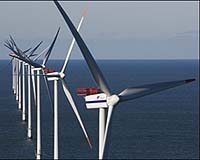
London (AFP) Aug 13, 2007 British officials have told government ministers that the country has no chance of meeting its commitments under European Union plans to raise the proportion of energy made from renewable sources by 2020, The Guardian reported on Monday. Citing an internal briefing paper for ministers that it had obtained, the newspaper said that officials believe that the best Britain can do is to produce nine percent of its energy from renewable sources by 2020 -- EU heads of state agreed earlier this year to target 20 percent over the 27-nation bloc. The paper, produced by what is now known as the Department for Business, Enterprise and Regulatory Reform (DBERR) in the early summer, said that Britain "has achieved little so far on renewables" and raising the proportion of renewables to nine percent, from two percent currently, would be "challenging." A spokesman for the DBERR declined to comment on the leaked documents, according to The Guardian, saying: "This government is committed to renewables and reducing emissions in line with EU targets." According to the internal document, Britain is currently on pace to raise its proportion of renewables to five percent. The briefing paper estimates that raising the proportion to nine percent would cost four billion pounds (5.9 billion euros, 8.1 billion dollars). It asks ministers to lobby their counterparts in France, Germany, Poland and Italy, as well as European commissioners, to create some flexibility, and also suggests ministers examine "what options there are for statistical interpretations of the target that would make it easier to achieve." The paper notes, however, that Germany is unlikely to be helpful in creating room to manouevre: "These flexible options are ones that may be difficult to negotiate with some member states such as Germany, who we expect to resist approaches that may be seen to water down the renewables target." EU heads of state agreed at their spring summit for renewables to account for 20.0 percent of energy consumption across the 27-country bloc by 2020. Individual targets for countries allowing the EU to achieve that overall goal were not set at the summit. Community Email This Article Comment On This Article Related Links Powering The World in the 21st Century at Energy-Daily.com
 Nanoparticle Technique Could Lead To Improved Semiconductors
 Austin TX (SPX) Aug 10, 2007
Devices made from plastic semiconductors, like solar cells and light-emitting diodes (LEDs), could be improved based on information gained using a new nanoparticle technique developed at The University of Texas at Austin. As electrical charges travel through plastic semiconductors, they can be trapped much like a marble rolling on a bumpy surface becomes trapped in a deep hole. These traps of charges are known as "deep traps," and they are not well understood. |
|
|
| The content herein, unless otherwise known to be public domain, are Copyright Space.TV Corporation. AFP and UPI Wire Stories are copyright Agence France-Presse and United Press International. ESA Portal Reports are copyright European Space Agency. All NASA sourced material is public domain. Additional copyrights may apply in whole or part to other bona fide parties. Advertising does not imply endorsement, agreement or approval of any opinions, statements or information provided by Space.TV Corp on any Web page published or hosted by Space.TV Corp. Privacy Statement |