|
50th Aniversary Of The Russian ICBM Rocket
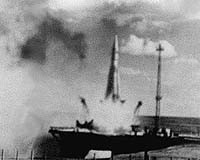
Korolev, Russia (SPX) Aug 23, 2007 Today is the 50th anniversary of the first successful launch of R-7 intercontinental ballistic missile developed at the Special Design Bureau No.1 (now S.P.Korolev RSC Energia). The first long-range two-stage intercontinental ballistic missile in our country was intended for delivering a warhead to any point on the territory of a potential enemy. The R-7 rocket design was fundamentally different from all the earlier rockets in terms of its configuration, loading patterns, dimensions, mass, propulsion system power, and its systems functionality. The lines drawing of the rocket was approved by S.P.Korolev on March 11, 1955. The rocket was launched on August 21, 1957 at 15 hours 25 minutes from the Baikonur launch site and ended successfully with the rocket reaching its designated target area in the Kamchatka peninsula. The missile was added to the arsenal of our country on January 20, 1960, and became one of the most important components of our country's nuclear missile shield. Development, manufacturing and launching of the missile involved dozens of companies and organizations throughout the country, including OKB-456 (V.P.Glushko), NII-885 (M.S.Ryazansky, N.A.Pilyugin), NII-3 (V.K.Shebanin), NII-4 (A.I.Sokolov), TsIAM (G.P.Svishchev), TsAGI (A.A.Dorodnitsin, V.V.Struminsky), NII-6 (V.A.Sukhikh), A.N.Steklov Mathematical Institute (M.V.Keldysh), etc. The key developers, designers and researchers for the missile at the Special Design Bureau No.1 were: B.Ye.Chertok, P.I.Yermolaev, K.D.Bushuev, S.S.Krukov, Ye.F.Ryazanov, I.P.Firsov, A.I.Nechaev, G.S.Vetrov, G.N.Degtyarenko, Ya,P.Kolyako, O.N.Voropaev, S.S.Lavrov, R.F.Appazov, P.F.Shulgin, P.A.Yershov, V.M.Udodenko, A.F.Kulyabin, V.F.Roshchin, A.F.Tyurikova, V.F.Gladky, O.D.Zherebin, S.F.Parmuzin, V.M.Protopopov, V.M.Liventsev, A.N.Voltsifer, V.A.Udaltsov, M.V.Melnikov, I.I.Raikov, B.A.Sokolov. Manufacturing and testing of the R-7 missile at factory No.88 of the Special Design Bureau No.1 (now Experimental Machine-Building Plant of RSC Energia) were supported by R.A.Turkov, V.M.Klyucharev, N.M.Berezin, S.K.Koltunov, V.M.Ivanov, I.V.Povarov, N.A.Pshenichnikov, A.V.Kirov, D.M.Shilov, A.G.Zigangirov, Yu.D.Manko, L.A.Medvedev, B.M.Afanasiev, A.N.Andrikanis and others. This missile became the basis for developing the first space launch vehicle Sputnik, which put the world's first Earth artificial satellite into obit. The R-7 rocket became the basis for developing its further modifications, intended for space launches - Vostok, Molniya, Soyuz launch vehicles, which made it possible for our country's space science to achieve many "firsts" in space. Present-day versions of the Soyuz launch vehicles, currently built by TsSKB Progress, launch manned spacecraft Soyuz TMA and unmanned cargo spacecraft Progress M under the program of the International Space Station. Soyuz launch vehicles are also used for launching other spacecraft in the interests of state and commercial customers. Further development of this rocket's design (Soyuz-2 project and others) is under way. Community Email This Article Comment On This Article Related Links Rocket Science News at Space-Travel.Com
 DELMIA Software To Help Refine Orion Physical Mockup
 Auburn Hills MI (SPX) Aug 22, 2007
Dassault Systemes, a leading supplier of 3D and Product Lifecycle Management (PLM) solutions, reports that its DELMIA software is helping Lockheed Martin Space Systems Co. (LMSSC) work more closely with the National Aeronautics and Space Administration (NASA). The focus of their efforts is on mockups for the crew exploration vehicle to be used in the Orion orbital and moon-landing missions. |
|
|
| The content herein, unless otherwise known to be public domain, are Copyright Space.TV Corporation. AFP and UPI Wire Stories are copyright Agence France-Presse and United Press International. ESA Portal Reports are copyright European Space Agency. All NASA sourced material is public domain. Additional copyrights may apply in whole or part to other bona fide parties. Advertising does not imply endorsement, agreement or approval of any opinions, statements or information provided by Space.TV Corp on any Web page published or hosted by Space.TV Corp. Privacy Statement |