|
A GLAST Of A Blast Off Should Bring Home The Gamma
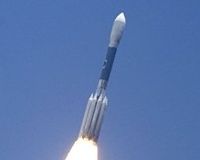
Cape Canaveral FL (SPX) Jun 12, 2008 NASA's Gamma-ray Large Area Space Telescope, or GLAST has been successfully launched aboard a Delta II rocket from Cape Canaveral Air Force Station in Florida at 12:05 p.m. EDT Wednesday Jun 11, 2008. The GLAST observatory separated from the second stage of the Delta II at 1:20 p.m. and the flight computer immediately began powering up the components necessary to control the satellite. Twelve minutes after separating from the launch vehicle, both GLAST solar arrays were deployed. The arrays immediately began producing the power necessary to maintain the satellite and instruments. The operations team continues to check out the spacecraft subsystems. "The entire GLAST Team is elated the observatory is now on-orbit and all systems continue to operate as planned," said GLAST program manager Kevin Grady of NASA's Goddard Space Flight Center in Greenbelt, Md. After a 75-minute flight, the GLAST spacecraft was deployed into low Earth orbit. It will begin to transmit initial instrument data after about three weeks. The telescope will explore the most extreme environments in the universe, searching for signs of new laws of physics and investigating what composes mysterious dark matter. It will seek explanations for how black holes accelerate immense jets of material to nearly light speed, and look for clues to crack the mysteries behind powerful explosions known as gamma-ray bursts. "After a 60-day checkout and initial calibration period, we'll begin science operations," said Steve Ritz, GLAST project scientist at Goddard. "GLAST soon will be telling scientists about many new objects to study, and this information will be available on the internet for the world to see." NASA's GLAST mission is an astrophysics and particle physics partnership, developed in collaboration with the U.S. Department of Energy, along with important contributions from academic institutions and partners in France, Germany, Italy, Japan, Sweden, and the U.S. Community Email This Article Comment On This Article Related Links GLAST Stellar Chemistry, The Universe And All Within It
 NASA Selects Three Research Fellows For GLAST Mission
 College Park MD (SPX) Apr 08, 2008
After a nationwide search for junior science researchers on NASA's Gamma-ray Large Area Telescope (GLAST) mission, three people have been chosen for these prestigious post-doctoral positions. The purpose of the fellowship program is to support outstanding postdoctoral scientists who endeavor to advance understanding of the gamma-ray universe. |
|
|
| The content herein, unless otherwise known to be public domain, are Copyright Space.TV Corporation. AFP and UPI Wire Stories are copyright Agence France-Presse and United Press International. ESA Portal Reports are copyright European Space Agency. All NASA sourced material is public domain. Additional copyrights may apply in whole or part to other bona fide parties. Advertising does not imply endorsement, agreement or approval of any opinions, statements or information provided by Space.TV Corp on any Web page published or hosted by Space.TV Corp. Privacy Statement |