

 |

Los Angeles CA (SPX) Feb 21, 2011 The more humanity acidifies and warms the world's oceans with carbon emissions, the harder we will have to work to save our coral reefs. That's the blunt message from a major new study by an international scientific team, which finds that ocean acidification and global warming will combine with local impacts like overfishing and nutrient runoff to weaken the world's coral reefs right when they are struggling to survive. Modelling by a team led by Dr Ken Anthony of the ARC Centre of Excellence for Coral Reef Studies and The University of Queensland's Global Change Institute has found that reefs already overfished and affected by land runoff are likely to be more vulnerable to increasing CO2 in the atmosphere caused by the burning of fossil fuels. Their study is the first to integrate global scale processes, such as warming and acidification, with the local factors overfishing and runoff, to predict the combined impact on coral reefs. "As CO2 levels climb to 450-500 parts per million - as they are now expected to do by 2050 - how well we manage local impacts on reefs like fishing and runoff will become absolutely critical as to whether they survive as coral reefs, or are overtaken by algae that compete with corals for space on reefs," Dr Anthony says. Warmer conditions cause periodic mass coral deaths by bleaching, while acidifying sea water - due to CO2 dissolving out of the atmosphere - weakens the corals by interfering with their ability to form their skeletons, making them more vulnerable to impact by storms. If the corals are also affected by heavy nutrient runoff from the land - which fertilizes the algae - and overfishing of parrot fishes and others that keep the reefs clear of weed, then corals can struggle to re-establish after a setback, he explains. "In those situations, the reef can become completely overgrown by algae." The team's modelling, which they say is on the conservative side, has far-reaching implications for the preservation even of well-managed reefs such as Australia's Great Barrier Reef - and extremely serious implications for reefs in developing countries, where most reefs are located and where reefs face high levels of stress from human activities. "Put simply, our model indicates that the more CO2 we humans liberate, the harder it will become for coral reefs, as we know them, to survive. This means they will need all the help they can get in the way of good management to prevent their being overgrown by sea weeds," he adds. "Coral reefs in developing nations, where most of the world's reefs occur and overfishing and nutrification remain key concerns, are particularly vulnerable, highlighting the need to continue to build capacity amongst reef managers and governments in areas like SE Asia," the team warns in their report, which was recently published in the journal Global Change Biology. "A failure to rapidly stabilize and reduce the concentration of CO2 in the Earth's atmosphere is likely to lead to significant loss of key (coral) framework builders such as Acropora, irrespective of the effectiveness of local management," the scientists conclude. "However local reef management efforts to maintain high grazing fish populations and prevent runoff of silt, fertilisers and sewage from the land will play a critical role in maintaining coral resilience while CO2 concentrations are stabilized", they add. The study, which is the first to quantify the relative importance of carbon emissions and local disturbances in compromising reef health, can be used to optimise future management practises of coral reefs. It makes clear that both policy changes on emissions and local management measures are required to secure a future for coral reefs. Their paper, "Ocean acidification and warming will lower coral reef resilience" by Kenneth R Anthony, Jeffery A Maynard, Guillermo Diaz-Pulido, Peter J Mumby, Paul A Marshall, Long Cao and Ove Hoegh-Guldberg appears in Global Change Biology (2011).
Share This Article With Planet Earth
Related Links - Water News - Science, Technology and Politics

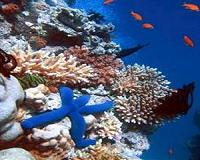 Extinction Predictor Will Help Protect Coral Reefs
Townsville, Australia (SPX) Feb 21, 2011 A new predictive method developed by an international team of marine scientists has found that a third of reef fishes studied across the Indian Ocean are potentially vulnerable to increasing stresses on the reefs due to climate change. The method also gives coral reef managers vital insights to better protect and manage the world's coral reefs, by showing that local and regional commitment ... read more |
|
|
| The content herein, unless otherwise known to be public domain, are Copyright 1995-2010 - SpaceDaily. AFP and UPI Wire Stories are copyright Agence France-Presse and United Press International. ESA Portal Reports are copyright European Space Agency. All NASA sourced material is public domain. Additional copyrights may apply in whole or part to other bona fide parties. Advertising does not imply endorsement,agreement or approval of any opinions, statements or information provided by SpaceDaily on any Web page published or hosted by SpaceDaily. Privacy Statement |


 del.icio.us
 Digg
Digg Reddit
 YahooMyWeb
 Google
 Facebook


