

 |

Albuquerque (UPI) Nov 26, 2010 When dinosaurs disappeared, the world's mammal species went on a growth binge and then hit an upper limit, all at about the same time, U.S. researchers say. Scientists at the University of New Mexico making a survey of big-mammal body size found mammal groups around the world tended to give rise to giant species at about the same time, ScienceNews.org reported Thursday. Such supersizing took about 20 million years after the disappearance of the dinosaurs, paleoecologist Felisa A. Smith says. The few mammal species that survived the catastrophe that wiped out dinosaurs started small, "about the size of a baseball, certainly not as big as a football," Smith says. But with dinosaurs gone, mammal groups diversified to fill new niches, and sizes shot up. It peaked with creatures like the Indricotherium, a rhinoceros-like mammal that weighed about 17 tons, and Deinotherium, tipping the scales at more than 18 tons. But by 40 million years ago sizes reached a plateau, the scientists say. Body size is limited roughly by the amount of land area available and by temperature, the researchers say, making them the major constraints that set a maximum body size.
Share This Article With Planet Earth
Related Links Explore The Early Earth at TerraDaily.com

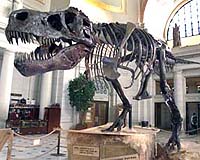 Big Tail Was Key To Speed And Hunting Prowess Of T Rex
Edmonton, Canada (SPX) Nov 16, 2010 Tyrannosaurus rex was far from a plodding Cretaceous era scavenger whose long tail only served to counterbalance the up-front weight of its freakishly big head. T. rex's athleticism (and its rear end) has been given a makeover by University of Alberta graduate student Scott Persons. His extensive research shows that powerful tail muscles made the giant carnivore one of the fastest moving h ... read more |
|
|
| The content herein, unless otherwise known to be public domain, are Copyright 1995-2010 - SpaceDaily. AFP and UPI Wire Stories are copyright Agence France-Presse and United Press International. ESA Portal Reports are copyright European Space Agency. All NASA sourced material is public domain. Additional copyrights may apply in whole or part to other bona fide parties. Advertising does not imply endorsement,agreement or approval of any opinions, statements or information provided by SpaceDaily on any Web page published or hosted by SpaceDaily. Privacy Statement |


 del.icio.us
 Digg
Digg Reddit
 YahooMyWeb
 Google
 Facebook


