

 |

Washington (UPI) Dec 16, 2010 The U.S. Air Force and its Lockheed Martin partner have successfully completed the final test of the first geosynchronous satellite, billed GEO-1. The announcement by the Air Force signaled a major accomplishment in a milestone program that "verifies the spacecraft's performance and functionality in preparation for delivery to the launch site," a Lockheed company statement said this week. The successful test confirmed forecasts that the Air Force's much-vaunted Space-Based Infrared System would be able to meet its launch deadline, set for the spring of 2011. The launch, from an Atlas V vehicle, will be staged from Cape Canaveral Air Force Station in Florida after as many as five delays since the program's start in 1996. The launch of the five-spacecraft constellation had originally been scheduled for September 2002. SBIRS is designed to provide early warning of missile launches. Military experts say the project's completion served as another example of government and related industry team commitment to the successful execution of a program critical for national security. "The joint government/industry team has made tremendous progress and demonstrated exceptional commitment in preparing the first SBIRS GEO spacecraft for launch," said Col. Roger Teague, the U.S. Air Force's SBIRS Wing Commander. "Successful completion of the final testing gives us high confidence in achieving SBIRS mission success to provide unprecedented, global, persistent, infrared surveillance capabilities to our nation," he said in remarks released by Lockheed. It is believed that the launch of GEO-1 will significantly enhance the nation's early missile warning capabilities. It will also afford "critical support," according to industry experts, of other key national security missions including defense, technical intelligence and battle-space awareness. The Defense Talk Web site said the "SBIRS Highly Elliptical Orbit payloads have already been launched and are meeting or exceeding all performance requirements." It is expected that expert crews with complete final space to ground interface system testing, perform spacecraft component installations and conduct a final factory confidence test. Dogged by delays, however, chronic problems spiked the program's cost growth between 2008 and 2013 in the military's satellite programs of about 97 percent -- to $22.3 billion from $11.4 billion. The program's cost has climbed to $11.6 billion, an increase of at least $6.9 billion, after starting at about $4.7 billion, the Air Force has said. "We look forward to and are keenly focused on preparing this first-of-its-kind spacecraft for launch to deliver critical new capabilities to our nation's warfighters for decades to come," said Jeff Smith, Lockheed Martin's SBIRS vice president.
Share This Article With Planet Earth
Related Links Learn about missile defense at SpaceWar.com Learn about nuclear weapons doctrine and defense at SpaceWar.com All about missiles at SpaceWar.com Learn about the Superpowers of the 21st Century at SpaceWar.com

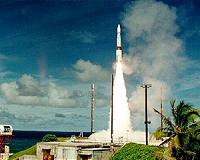 Cause of missile defense test failure unclear: US
Washington (AFP) Dec 16, 2010 A top US general said Thursday it was unclear why an interceptor meant to knock out incoming ballistic missiles failed in a test for the second time in a row. General James Cartwright, the military's second highest ranking officer, said he had no doubts that the country's missile defense system could fend off potential threats, despite Wednesday's failed test. "I'm not the least bit conc ... read more |
|
|
| The content herein, unless otherwise known to be public domain, are Copyright 1995-2010 - SpaceDaily. AFP and UPI Wire Stories are copyright Agence France-Presse and United Press International. ESA Portal Reports are copyright European Space Agency. All NASA sourced material is public domain. Additional copyrights may apply in whole or part to other bona fide parties. Advertising does not imply endorsement,agreement or approval of any opinions, statements or information provided by SpaceDaily on any Web page published or hosted by SpaceDaily. Privacy Statement |


 del.icio.us
 Digg
Digg Reddit
 YahooMyWeb
 Google
 Facebook


