|
 |
 |
 |
 |
 |
 |
 |
 |

 |
Ancient Climate Secrets Raised From Ocean Depths
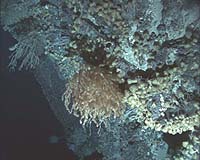
Canberra, Australia (SPX) Feb 04, 2008 Using a remotely operated submersible vehicle the international research team captured images of life found on deep-sea pinnacles and valleys up to three kilometres beneath the Ocean's surface. During a three-week voyage, scientists from CSIRO's Wealth from Oceans National Research Flagship and the US, collaborated to retrieve examples of live and fossilised deep-ocean corals from a depth of 1 650 metres near the Tasman Fracture Zone, south-east of Tasmania. "These corals are evidence of an extinct coral reef," says the voyage's Chief Scientist, CSIRO Marine and Atmospheric Research's Dr Ron Thresher. "Our sampling came up with some very old fossil corals of the type we are now seeing live and forming extensive reefs at depths of 800-1300 metres. This suggests that the reef extended much deeper in the past, but how long ago or why it died out, we don't know yet," he says. The composition of deep-sea corals is used to determine past ocean conditions, such as temperature, salinity and the mixing of surface and deep-water layers, over tens to hundreds of thousands of years. Dr Thresher says over the coming year the samples will be examined to determine when these newly discovered reefs existed and if their extinction can be related to long-term climate patterns. The findings will provide ancient climate data that contribute to models of regional and global climate change, based on historical circulation patterns in the Southern Ocean. He says that at times the submersible vehicle - or Autonomous Benthic Explorer (ABE), on loan from the Woods Hole Oceanographic Institution (WHOI) - was pushed off course while exploring the extreme depths and, in two cases, had its forward progress stopped altogether. Such movements enabled researchers to identify previously unknown and unexpectedly strong, deep currents. "The voyage was a success despite some of the roughest conditions ever experienced by the team, particularly in deploying the ABE," Dr Thresher says. The voyage is part of a collaboration between CSIRO's Wealth from Oceans Flagship, WHOI in the US, the National Science Foundation in the US, the marine division of the Australian Department of Environment, Water, Heritage and the Arts and, the Marine National Facility. Community Email This Article Comment On This Article Related Links CSIRO Climate Science News - Modeling, Mitigation Adaptation
 Microbes As Climate Engineers
 Edinburgh, UK (SPX) Jan 31, 2008
We might think we control the climate but unless we harness the powers of our microbial co-habitants on this planet we might be fighting a losing battle, according to an article in the February 2008 issue of Microbiology Today. Humans are continually altering the atmosphere. |
|
|
| The content herein, unless otherwise known to be public domain, are Copyright Space.TV Corporation. AFP and UPI Wire Stories are copyright Agence France-Presse and United Press International. ESA Portal Reports are copyright European Space Agency. All NASA sourced material is public domain. Additional copyrights may apply in whole or part to other bona fide parties. Advertising does not imply endorsement, agreement or approval of any opinions, statements or information provided by Space.TV Corp on any Web page published or hosted by Space.TV Corp. Privacy Statement |