
 |
 |
 |
 |
 |
 |
 |
 |
 |

 |
Arctic Could Lose Most Ice In 30 Years
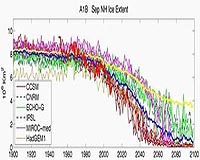
Washington DC (SPX) Apr 03, 2009 A nearly ice-free Arctic Ocean in the summer may happen three times sooner than scientists had previously estimated. A new analysis of computer models coupled with the most recent summer ice measurements indicates that the Arctic might lose most of its ice cover in summer in 30 years. Scientists don't expect the Arctic to become totally ice free, because ice will remain along northern Canada and Greenland. Powerful winds there sweep across the Arctic Ocean, forcing ice layers to slide on top of each other, building up a very thick ice cover. "The Arctic is changing faster than anticipated," says James Overland of the National Oceanographic and Atmospheric Administration (NOAA). "It's a combination of natural variability, along with warmer air and sea conditions caused by increased greenhouse gases." Overland and Muyin Wang of the University of Washington, in Seattle, will publish their findings on April 3 in Geophysical Research Letters, a publication of the American Geophysical Union (AGU). The amount of the Arctic Ocean covered by ice at the end of summer by 2037 could be only about 1 million square kilometers (about 620,000 square miles.) That's compared to today's ice extent of 4.6 million square kilometers (2.8 million square miles.) So much more open water could be a boon for shipping and for extracting minerals and oil from the seabed, but it could also cause an ecosystem upheaval. The United Nations Intergovernmental Panel on Climate Change in 2007 assessed what might happen in the Arctic in the future by running 23 global climate models. But Wang, a climate scientist, and Overland, an oceanographer with NOAA's Pacific Marine Environmental Laboratory in Seattle, reasoned that dramatic declines in the extent of ice at the end of summer in 2007 and 2008 called for a more refined approach. The new projections are based on those six of the 23 models that are most suited for assessing sea ice, according to Wang, the lead author of the study. She and Overland sought models that best matched what has actually happened in recent years. Among the models eliminated were those showing way too little ice or way too much ice compared to conditions that have occurred. Wang says she and Overland chose models that accurately reflect the difference between summer and winter ice packs. That distinction demonstrates the model's ability to take into account changing amounts of solar radiation. Among the six models fitting the researchers' criteria, three have sophisticated sea-ice physics and dynamics capabilities. Once the extent of ice at the end of summer drops to 4.6 million square kilometers - it was actually 4.3 million square kilometers in 2007 and 4.7 million in 2008 - all six models show rapid sea-ice declines. Averaged together, the models point to a nearly ice-free Arctic in 32 years, with some of the models putting the event as early as 11 years from now. Share This Article With Planet Earth
Related Links National Oceanographic and Atmospheric Administration (NOAA) Beyond the Ice Age
 Clinton to host first Arctic-Antarctic meeting
 Washington (AFP) April 1, 2009
US Secretary of State Hillary Clinton next week will host the first diplomatic meeting concerning the use of both the Arctic and Antarctic, her department said Wednesday. |
|
|

| The content herein, unless otherwise known to be public domain, are Copyright 1995-2007 - SpaceDaily.AFP and UPI Wire Stories are copyright Agence France-Presse and United Press International. ESA Portal Reports are copyright European Space Agency. All NASA sourced material is public domain. Additional copyrights may apply in whole or part to other bona fide parties. Advertising does not imply endorsement,agreement or approval of any opinions, statements or information provided by SpaceDaily on any Web page published or hosted by SpaceDaily. Privacy Statement |
 del.icio.us
 Digg
Digg Reddit
 YahooMyWeb
 Google
 Facebook