
 |
 |
 |
 |
 |
 |
 |
 |
 |

 |
Arctic may be ice-free in 30 years: study
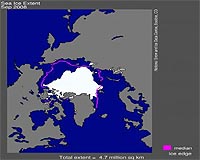
Washington (AFP) April 3, 2009 Some 80 percent of Arctic ice may disappear in 30 years, not 90 as scientists had previously estimated, according to a new study on the impact of global warming. "The amount of the Arctic Ocean covered by ice at the end of summer by then could be only about 1 million square kilometers, or about 620,000 square miles," said US researchers who authored the study published Thursday. "That's compared to today's ice extent of 4.6 million square kilometers, or 2.8 million square miles," they added, warning the development "raises the question of ecosystem upheaval." The scientists made their projections based on models that took accounted for changes in Arctic ice, which saw "dramatic declines" at the end of summer in 2007 and 2008, when the ice surface dropped to 4.3 and 4.6 million square kilometers (1.7 and 1.8 million square miles), respectively. The models pointed to a "nearly ice-free" Arctic in just 32 years, with some of the models making the same prediction for 11 years from now. "In recent years, the combination of unusual warm temperatures from natural causes and the global warming signal have worked together to provide an earlier summer sea-ice loss than was predicted," said James Overland of the National Oceanic and Atmospheric Administration (NOAA). Overland and co-author Muyin Wang of the University of Washington said earlier models had predicted the event would not take place before the end of the 21st century. Maps illustrating Overland and Wang's models showed a nearly ice-free Arctic Ocean, although some ice would remain along northern Canada and Greenland, where powerful winds make for very thick layers of ice. The researchers noted one benefit of less ice in the Arctic: "a boon for shipping and for extracting minerals and oil from the seabed." Share This Article With Planet Earth
Related Links Beyond the Ice Age
 Arctic Could Lose Most Ice In 30 Years
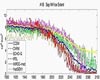 Washington DC (SPX) Apr 03, 2009
A nearly ice-free Arctic Ocean in the summer may happen three times sooner than scientists had previously estimated. A new analysis of computer models coupled with the most recent summer ice measurements indicates that the Arctic might lose most of its ice cover in summer in 30 years. |
|
|

| The content herein, unless otherwise known to be public domain, are Copyright 1995-2007 - SpaceDaily.AFP and UPI Wire Stories are copyright Agence France-Presse and United Press International. ESA Portal Reports are copyright European Space Agency. All NASA sourced material is public domain. Additional copyrights may apply in whole or part to other bona fide parties. Advertising does not imply endorsement,agreement or approval of any opinions, statements or information provided by SpaceDaily on any Web page published or hosted by SpaceDaily. Privacy Statement |
 del.icio.us
 Digg
Digg Reddit
 YahooMyWeb
 Google
 Facebook