
 |
 |
 |
 |
 |
 |
 |
 |
 |

 |

Washington DC (SPX) Jul 14, 2010 The U.S. Army is planning a brigade combat team integration exercise at White Sands Missile Range, N.M., July 12-16, 2010, which will connect Soldiers, sensors, unmanned aerial vehicles, networked vehicles on-the-move, command posts and other nodes over long distances through satellite and software-programmable radio as part of an effort to evaluate the progress of its battlefield network. "We are going to stress the network to see how far we can go to extend the network. It is not a test - but an integration exercise. We are going to see what this demonstration can do - learn from it --- and then if necessary adjust our programs," said Lt. Gen. Bill Phillips, principal military deputy to the assistant secretary of the Army for Acquisition, Logistics and Technology. The exercise, which is envisioned as a key step within the larger developmental trajectory of the Army's battlefield network, is aimed at informing the developmental cycle. It will involve less than 100 Soldiers and engineers at Fort Bliss, Texas, who will place Soldiers and technologies in a series of vignettes designed to stress and evaluate the network's multi-node terrestrial layer and broader satellite connectivity. "This will inform the Army's network development strategy as part of an ongoing process by bringing all of the piece parts together in an integrated fashion. This is the first time we have begun to connect from soldier-leader levels up to company, brigade, battalion and beyond," said Paul Mehney, a spokesman for PEO Integration. The exercise is designed to be separate and distinct from a planned Limited User Test of Increment 1 capabilities slated for September of this year; as opposed to functioning as part of a formal procurement cycle prior to a Milestone C procurement decision, the exercise is purely aimed at pushing the envelope of technological possibility as a way to further the learning process, officials said. The idea will be to connect network nodes to one another through one seamless battlefield network wherein Soldiers, commanders and sensors can share voice, video, data and images across the force in real time. Vehicles outfitted with Network Integration Kits will serve as key network hubs connecting the terrestrial and satellite layers of the network to one another. The NIKs consist of an Integrated Computer System, JTRS Ground Mobile Radio and Blue Force Tracker display screen. A terrestrial network of sensors will send voice, images and data through Joint Tactical Radio Systems, or JTRS software programmable radios using high bandwidth waveforms such as Solder Radio Waveform, or SRW; the information sent and received by the terrestrial layer will be connected to Warfighter Information Network-Tactical,or WIN-T, a satellite network able to send information over long distances. "The plan is to connect the echelons. I will have the ability to take a picture of a vehicle three or four kilometers in front of me. I will be able to bring that image into the network and then I will be able to send that image from Fort Bliss, Texas, back over WIN-T to Aberdeen Proving Ground, Md.," said Col. Michael Williamson, deputy program executive officer, Networks, PEO Integration. By connecting the echelons to one another, dismounted soldiers carrying a JTRS Rifleman Radio or JTRS Handheld Manpack Small radio will be able to instantly share information across the squad, platoon, company and battalion levels and, if needed, all the way up to commanders at higher headquarters or command posts. Sending voice, video and images through SRW, sensors such as the Unattended Ground Sensors, Small Unmanned Ground Robots and Class I UAS systems will instantaneously share information across the force; the NIKs will have the ability to view and share the sensor information in real time on Blue Force Tracking display screens in vehicles on-the-move - and WIN-T can then beam the images over longer distances. The data will be shown on a Command Post of the Future display screen - a battle command application which organizes and displays a host of relevant battlefield information. The exercise will also include an air tier with Apache and Black Hawk helicopters and a Shadow UAS configured to function as nodes on the network connecting groups of soldiers to one another who are separated by terrain and do not have a line-of-sight connection. "There will be a shadow UAV flying over brigade combat teams. The data will be connected to the sensors to allow commanders and soldiers at various levels to see those sensors," said Phillips. The exercise is planned as merely an initial step in the broader development of the Army's network. "This is about how I get more capability to Soldiers and continue to build this network. Success is understanding the process of integrating multiple programs. What I am looking for is an enduring process to see what technologies are out there and how they are maturing," said Williamson. "In the long run we will save DoD money," he said, "because we will understand what is really possible."
Share This Article With Planet Earth
Related Links - Read the latest in Military Space Communications Technology at SpaceWar.com

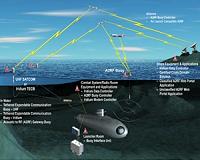 Critical Design Review For U.S. Navy CSD Program
Marion MA (SPX) Jul 13, 2010 A Lockheed Martin-led industry team has completed a successful critical design review for a system that will give U.S. Navy submarines real-time, two-way communications without requiring platforms to proceed to periscope depth. The review clears the way for the team to begin producing hardware and to deliver engineering design models in early 2011. Currently, submarines must come to ... read more |
|
|
| The content herein, unless otherwise known to be public domain, are Copyright 1995-2010 - SpaceDaily. AFP and UPI Wire Stories are copyright Agence France-Presse and United Press International. ESA Portal Reports are copyright European Space Agency. All NASA sourced material is public domain. Additional copyrights may apply in whole or part to other bona fide parties. Advertising does not imply endorsement,agreement or approval of any opinions, statements or information provided by SpaceDaily on any Web page published or hosted by SpaceDaily. Privacy Statement |


 del.icio.us
 Digg
Digg Reddit
 YahooMyWeb
 Google
 Facebook


