
 |
 |
 |
 |
 |
 |
 |
 |
 |

 |

Washington DC (SPX) Oct 26, 2010 An asteroid crashing into the deep ocean could have dramatic worldwide environmental effects including depleting the Earth's protective ozone layer for several years, a Planetary Science Institute researcher has found. This could result in a huge spike in ultraviolet radiation levels and hamper efforts to grow crops, as well as affect other life forms on Earth. A medium-sized asteroid - between 500 meters and one km in diameter - smashing into Earth's deep oceans would send vast amounts of seawater into the air, said Elisabetta Pierazzo, PSI senior scientist. In the past, the interest in the effects of oceanic impacts of medium sized asteroids have focused on the danger of regional tsunami, but Pierazzo's new approach, published recently in Earth and Planetary Science Letters, has used computer modeling scenarios to look at the effects such a strike would have on the atmospheric ozone. Working with a team of atmospheric scientists, she looked at two asteroid impact scenarios: 500 meter and one km diameter asteroids impacting an ocean 4 km deep. "This work represents the first attempt at combining impact simulations with a three-dimensional shock physics code and atmospheric simulations using a general circulation model with interactive chemistry," she said. "The results suggest that mid-latitude oceanic impact of one km asteroids can produce significant global perturbation of upper atmospheric chemistry, including multi-year global ozone depletion comparable to record ozone holes recorded in the mid 1990s." The modeling depicted how rapidly ejected seawater, included as water vapor and compounds like chloride and bromide that hasten the destruction of the ozone, would affect atmospheric chemistry, said Pierazzo, the paper's lead author and project principal investigator. "The removal of a significant amount of ozone in the upper atmosphere for an extended period of time can have important biological repercussions at the Earth's surface as a consequence of increase in surface UV-B irradiance," she said. "These include increased incidence of erythema (skin reddening), cortical cataracts, changes in plant growth and changes in molecular DNA." While technology does not currently exist for diverting or destroying an asteroid headed for Earth, with enough lead-time and preparation the long-term consequences of such an impact can be diminished, she said. Farmers could plant crops with higher tolerance to UV radiation to make up for the types that would not thrive, or survive, because of the breached ozone layer, she said. Food could be stored to prepare for a few years of reduced productivity, both on land and in the ocean. The spike in UV radiation would also affect humans and animals, she said. The ultraviolet index, or UVI, is a scale used to indicate the intensity of UV radiation at the Earth's surface, and the higher the number the greater chance of damage to the skin and eyes. A UVI of 10 or greater tends to be dangerous, resulting in burns to people with fair skin in a few minutes exposure, she said. The highest UVI recorded on Earth has been 20, she said. The results of a 500-meter asteroid impact could see the UVI jump to values above 20 for several months in the northern subtropics, and an impact by a 1 km asteroid would see the UVI rise up to 56, with levels exceeding 20 for about two years south of about 50 degrees latitude in both hemispheres, she said. "A level of 56 has never been recorded before, so we are not sure what it is going to do," she said. "It would be produce major sunburn. We could stay inside to protect ourselves, but if you go outside during daylight hours you would burn. You would have to go outside at night, after sunset, to avoid major damage." The research was funded by a NASA Exobiology grant.
Share This Article With Planet Earth
Related Links Planetary Science Institute All about the Ozone Layer

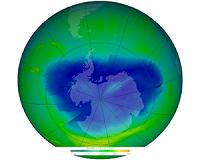 UN scientists say ozone layer depletion has stopped
Geneva (AFP) Sept 16, 2010 The protective ozone layer in the earth's upper atmosphere has stopped thinning and should largely be restored by mid century thanks to a ban on harmful chemicals, UN scientists said on Thursday. The "Scientific Assessment of Ozone Depletion 2010" report said a 1987 international treaty that phased out chlorofluorocarbons (CFC) - substances used in refrigerators, aerosol sprays and some pac ... read more |
|
|
| The content herein, unless otherwise known to be public domain, are Copyright 1995-2010 - SpaceDaily. AFP and UPI Wire Stories are copyright Agence France-Presse and United Press International. ESA Portal Reports are copyright European Space Agency. All NASA sourced material is public domain. Additional copyrights may apply in whole or part to other bona fide parties. Advertising does not imply endorsement,agreement or approval of any opinions, statements or information provided by SpaceDaily on any Web page published or hosted by SpaceDaily. Privacy Statement |


 del.icio.us
 Digg
Digg Reddit
 YahooMyWeb
 Google
 Facebook


