
 |
 |
 |
 |
 |
 |
 |
 |
 |

 |

Los Angeles CA (SPX) May 02, 2011 Scientists have captured and studied the collision of two asteroids for only the second time in the history of astronomy. In the May 20 edition of the Astrophysical Journal Letters (currently online), UCLA's David Jewitt and colleagues report on observations from NASA's Hubble Space Telescope of a large asteroid that was hit by a much smaller one. On Dec. 11, 2010, astronomers noticed that an asteroid known as (596) Scheila had unexpectedly brightened and was sporting short-lived dust plumes. Data from NASA's Swift satellite and Hubble Space Telescope showed that these changes likely occurred after Scheila was struck by a much smaller asteroid, probably in late November or early December. The shape, evolution and content of the plumes enabled the scientists to reconstruct what occurred. The smaller asteroid crashed into Scheila with the energy of at least a 100 kiloton nuclear bomb. The smallest particles from the collision escaped, and the dust formed plumes. These plumes were barely visible when Hubble observed Scheila two weeks later, and within two months, the plumes were gone completely, along with the evidence that Scheila had suffered a violent collision. "The Hubble data are most simply explained by the impact, at 11,000 miles per hour, of a previously unknown asteroid about 100 feet in diameter," said Jewitt, the Hubble team leader and a UCLA professor of Earth and space sciences and of physics and astronomy. Asteroids are rocky fragments thought to be debris from the formation and evolution of the solar system approximately 4.6 billion years ago. Millions of them orbit the sun between Mars and Jupiter, in the main asteroid belt. At 70 miles in diameter, Scheila is one of the largest. It orbits every five years, at about three times the Earth's distance from the sun. Three days after the outburst was announced, NASA's Swift Ultraviolet/Optical Telescope (UVOT) captured a spectrum of the asteroid to search for gas but found none. The absence of gas around Scheila led the Swift team to reject alternative scenarios where exposed ice accounted for the activity. Hubble observations on Dec. 27, 2010, and Jan. 4, 2011, were best explained by a collision with a small asteroid impacting Scheila's surface at an angle of less than 30 degrees, leaving a crater 1,000 feet across. Jewitt and his colleagues estimated the crash ejected more than 660,000 tons of dust - equivalent to nearly twice the mass of New York's Empire State Building. "Previously thought to be beyond the reach of direct observation, collisions are the main process by which asteroids are destroyed and dust is made in the solar system," said Jewitt, who is a member of UCLA's Institute for Geophysics and Planetary Physics and lead author of the journal article. "An asteroid collision with the Earth 65 million years ago wiped out the dinosaurs. So, although they're rare, it's important to use every example to figure out what happens when two rocks smash together at unimaginable speed." The research is illustrated in a NASA-produced video.
Share This Article With Planet Earth
Related Links UCLA Asteroid and Comet Mission News, Science and Technology

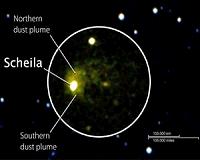 NASA's Swift and Hubble Probe Asteroid Collision Debris
Greenbelt MD (SPX) Apr 29, 2011 Late last year, astronomers noticed an asteroid named Scheila had unexpectedly brightened, and it was sporting short-lived plumes. Data from NASA's Swift satellite and Hubble Space Telescope showed these changes likely occurred after Scheila was struck by a much smaller asteroid. "Collisions between asteroids create rock fragments, from fine dust to huge boulders, that impact planets and t ... read more |
|
|
| The content herein, unless otherwise known to be public domain, are Copyright 1995-2010 - SpaceDaily. AFP and UPI Wire Stories are copyright Agence France-Presse and United Press International. ESA Portal Reports are copyright European Space Agency. All NASA sourced material is public domain. Additional copyrights may apply in whole or part to other bona fide parties. Advertising does not imply endorsement,agreement or approval of any opinions, statements or information provided by SpaceDaily on any Web page published or hosted by SpaceDaily. Privacy Statement |


 del.icio.us
 Digg
Digg Reddit
 YahooMyWeb
 Google
 Facebook


