
 |
 |
 |
 |
 |
 |
 |
 |
 |

 |
Astronauts fail to budge stuck cargo carrier
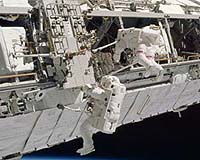
Washington (AFP) March 23, 2009 The Discovery astronauts were unable to dislodge a stuck cargo carrier system during their third and final space walk Monday, and carried on with their busy to-do list on the orbiting space station, NASA said. Richard Arnold and Joseph Acaba, two former science teachers turned astronauts, emerged from the decompression chamber at 1537 GMT, some six minutes earlier than planned. One of their tasks during a six-and-a-half hour walk in space was to unblock the external cargo carrier after Acaba and fellow astronaut Steven Swanson inadvertently inserted a restraining pin upside down on Saturday. Their attempts to fully deploy the system, however, were unsuccessful and mission control told them to stop trying and secure the system with "long-duration tethers," which will protect the hardware until another attempt can be made in the future. "Because the problem is not yet understood, Mission Control cancelled Acaba and Arnold's installation of a similar payload attachment system on the starboard side" of the ISS, NASA said. Discovery and the International Space Station (ISS) maneuvered into lower orbit Sunday to avoid a piece of floating debris that could have passed close by during Monday's spacewalk. Discovery's steering jets turned the shuttle and space station 180 degrees for three hours to increase drag, which altered the vessel's trajectory, lowering it by two miles (3.3 kilometers) to avoid the debris, explained NASA spokesman Bill Jeffs. The object, which measures a little over 10 centimeters (four inches), came from a Chinese rocket launched in 1999 that broke up in March 2000. The most important task during the third spacewalk is to reposition an equipment cart from one side to another of the Mobile Transporter, the ISS's rail line. The cart is used in the maintenance of the station's Canadian-built robot arm and the Dextre service robot. The robot arm will move the cart to another worksite at the station for tasks to be performed in upcoming space shuttle missions. Elsewhere on the ISS, experts were working on a water-recycling unit that processes astronauts' urine and sweat into drinking water. A replacement part was brought by the Discovery and testing began Sunday. The samples will be taken back to Earth for analysis. The machine, which was delivered to the ISS in November -- and has not yet functioned properly -- is key to sustaining a bigger crew on the orbiting station and for long-term space expeditions, such as moon landings or missions to Mars. Carrying large amounts of water aboard the shuttle or other space vessels is expensive and takes up room needed for other equipment. The two astronauts will also grease the hand joints of the ISS's robot arm and will install a thermal blanket on the Dextre robot. Dextre can be attached to the robot arm to manipulate small objects for tasks usually completed by an astronaut. One of the Discovery mission's biggest tasks was to deliver the last set of solar arrays, which were successfully unfurled Friday. The ISS now has four solar panels, two per wing, containing 32,800 cells that convert sunlight into electricity. They will boost the outpost's full power generation from 90 to 120 kilowatts, providing the power the space station needs to carry out scientific experiments aboard Kibo and the European Columbus laboratory. The additions also make it possible to double the space station's crew from three to six, beginning in May. Discovery's latest mission, which blasted off last Sunday from Florida with a crew of seven astronauts, is one of the last major efforts in a decade-long push by 16 countries to build the 100-billion-dollar outpost in space. NASA has scheduled nine shuttle flights through 2010 to finish building the space station. Upcoming shuttle flights also include the last mission to service the orbiting Hubble telescope in May. Discovery is due to land back on Earth on March 28 at 1742 GMT, two days after a Russian Soyuz mission takes off for the ISS carrying a crew of three, including US billionaire businessman Charles Simonyi, who has shelled out 35 million dollars for his second trip as a space tourist. On Discovery, crew member Koichi Wakata became the first Japanese astronaut to join the ISS for a long stay. He is scheduled to remain on the orbiting station until June. The Discovery mission, delayed five times, is the first by a US space shuttle in 2009. Share This Article With Planet Earth
Related Links Station at NASA Station and More at Roscosmos S.P. Korolev RSC Energia Watch NASA TV via Space.TV Space Station News at Space-Travel.Com
 Discovery crew embarks on third spacewalk
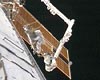 Washington (AFP) March 23, 2009
Astronauts from the US space shuttle Discovery began their third and final spacewalk Monday, with a busy to-do list including unblocking a cargo carrier system on the space station, NASA said. |
|
|

| The content herein, unless otherwise known to be public domain, are Copyright 1995-2007 - SpaceDaily.AFP and UPI Wire Stories are copyright Agence France-Presse and United Press International. ESA Portal Reports are copyright European Space Agency. All NASA sourced material is public domain. Additional copyrights may apply in whole or part to other bona fide parties. Advertising does not imply endorsement,agreement or approval of any opinions, statements or information provided by SpaceDaily on any Web page published or hosted by SpaceDaily. Privacy Statement |
 del.icio.us
 Digg
Digg Reddit
 YahooMyWeb
 Google
 Facebook