
 |
 |
 |
 |
 |
 |
 |
 |
 |

 |
Astronomical Collaboration Expected On Antarctic And Space Telescopes
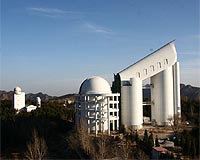
Beijing (XNA) Nov 20, 2008 A world leading astronomer said Wednesday that international collaboration on building new, powerful telescopes in Antarctica and space would trigger major breakthroughs in scientific research. University of Chicago Prof. Donald York said in an email interview with Xinhua, "There are many areas of possible collaboration internationally. One is in developing the completely new capabilities unique to Dome A in Antarctica. A second is in developing new telescopes in space, which have reached a size and scale hard for any one country to pay for, at a level that leads to big gains over past work." Prof. York, founding director of the multinational-collaborated Sloan Digital Sky Survey (SDSS), was invited by the Chinese Academy of Sciences (CAS) to co-chair a scientific committee offering advice to the China-made Large Sky Area Multi-Object Fiber Spectroscopic Telescope (LAMOST). The SDSS-inspired LAMOST, which cost 235 million yuan (34.4 million U.S. dollars) from the national research fund, has an effective aperture of over four meters, the biggest of its kind in the world, and 4,000 optical fibers that can simultaneously track space and decode starlight into enormous amounts of spectrographic data. "LAMOST, 5.5 times that of SDSS and a bigger advantage over anything else, can do more than SDSS if they (Chinese astronomers) get high throughput for the entire system," Prof. York said. The American astronomer said a third area of possible global collaboration would be in statistical astronomy and practical matters related to it, which is relevant to LAMOST. Unlike SDSS, the LAMOST system was innovatively designed by Chinese astronomers 24 honeycomb-shaped flat thin plates to become a reflecting mirror. The bigger-sized primary mirror consists of 37 spherical hexagonal cells in a similar structure. The active optics system that deforms the correcting mirror's 24 plates could compensate for the spherical aberration of the primary mirror and bringing both mirrors into focus simultaneously. The features make LAMOST be able to acquire highest spectrum in the world, with both large clear aperture and wide field of view. Citing Chinese astronomers as world astronomers, Prof. York, however, said that young astronomers in China do not seem to have as much experience on small telescopes where they can create and develop new programs on their own. He said observational discoveries, the breakthroughs that come from "finding out what is actually out there" rather than using theory to predict what is out there, now mainly have three paths: small telescopes operated by individuals for their own, new, unique ideas; large telescopes for detailed study of individual objects or for small surveys of very high reshift space; and statistical astronomy with medium sized telescopes run in survey mode to get millions of objects. Supporting his view on importance of small telescopes, Prof. York said several of the truly major discoveries in the last decade, including the super-novae evidence for dark energy in the universe, have come from telescopes of less than four meters aperture.
Source: Xinhua News Agency Share This Article With Planet Earth
Related Links Large Sky Area Multi-Object Fiber Spectroscopic Telescope (LAMOST) Space Telescope News and Technology at Skynightly.com
 New Telescope Features Giant CCD Camera
 Cambridge MA (SPX) Nov 19, 2008
Silicon chips developed at MIT Lincoln Laboratory are at the heart of a new survey telescope that will soon provide a more than fivefold improvement in scientists' ability to detect asteroids and comets that could someday pose a threat to the planet. |
|
|

| The content herein, unless otherwise known to be public domain, are Copyright 1995-2007 - SpaceDaily.AFP and UPI Wire Stories are copyright Agence France-Presse and United Press International. ESA Portal Reports are copyright European Space Agency. All NASA sourced material is public domain. Additional copyrights may apply in whole or part to other bona fide parties. Advertising does not imply endorsement,agreement or approval of any opinions, statements or information provided by SpaceDaily on any Web page published or hosted by SpaceDaily. Privacy Statement |
 del.icio.us
 Digg
Digg Reddit
 YahooMyWeb
 Google
 Facebook