
 |
 |
 |
 |
 |
 |
 |
 |
 |

 |
Astronomy Question Of The Week: Why Is The Sky Alight
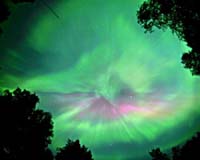
Bonn, Germany (SPX) Apr 28, 2009 There have been accounts of what are known as auroras - the eerie reddish and greenish flickering of light in the night sky - for the past 2000 years. The Vikings interpreted the luminous effect as being the shimmer of moonlight on the armour of the ghostly Valkyries as they rode across the sky. But why do auroras occur? Astronomy provides us with a scientific explanation for the 'fire in the sky': auroras are created when the solar wind meets the Earth's atmosphere. Solar wind is the name given to the stream of electrically charged particles (for example electrons and protons) that the Sun radiates into space. However, Earth is not completely defenceless against this solar bombardment - its magnetic field shields the Earth's surface from the majority of the high-energy particles.
The solar wind causes the Earth's sky to light up The shower of particles there causes air molecules to glow: highly excited oxygen atoms at a height of around 100 kilometres emit green light and red light originates from oxygen atoms at a height of around 200 kilometres. Very large amounts of energy are necessary to excite nitrogen atoms, which then emit light that is violet to blue in colour. In mid-latitude regions, including most of Europe, auroras are unusual events. They usually have a red colour here, as only rarely can the solar wind penetrate more deeply inside the atmosphere. Share This Article With Planet Earth
Related Links German Aerospace Center Solar Science News at SpaceDaily
 Giant Electrical Tornadoes In Space Drive The Northern Lights
 Vienna, Austria (SPX) Apr 27, 2009
Earth-bound tornadoes are puny compared to "space tornadoes," which span a volume as large as Earth and produce electrical currents exceeding 100,000 amperes, according to new observations by a suite of five NASA space probes. |
|
|

| The content herein, unless otherwise known to be public domain, are Copyright 1995-2007 - SpaceDaily.AFP and UPI Wire Stories are copyright Agence France-Presse and United Press International. ESA Portal Reports are copyright European Space Agency. All NASA sourced material is public domain. Additional copyrights may apply in whole or part to other bona fide parties. Advertising does not imply endorsement,agreement or approval of any opinions, statements or information provided by SpaceDaily on any Web page published or hosted by SpaceDaily. Privacy Statement |
 del.icio.us
 Digg
Digg Reddit
 YahooMyWeb
 Google
 Facebook