|
 |
 |
 |
 |
 |
 |
 |
 |

 |
Atomic expert questions US claim over Syrian 'reactor'
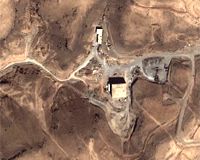
Vienna (AFP) April 26, 2008 A nuclear physicist close to the United Nations atomic watchdog cast doubt Saturday on the veracity of US intelligence which claimed that Syria had been building a secret atomic reactor. "When you look at the (US intelligence services) pictures, they show only raw construction," an expert close to the International Atomic Energy Agency (IAEA) told AFP on condition on anonymity. "It was just the shell of a site, and the walls did not look like the ones needed for a plutonium reactor." Walls of a plutonium reactor "need a lot of piping, there was nothing like that on the pictures," he added. On Thursday, US national security officials briefed US lawmakers, presenting intelligence they said showed Syria had been building a secret nuclear reactor with a military purpose. They said it was being built with the help of North Korea, until the facility was destroyed by Israel in a bombing attack on September 6, 2007 -- prompting the IAEA to launch a probe on Friday. The US evidence comprised photographs taken inside the reactor showing construction of the shield for the reactor core, and control rods and refuelling ports on top of the reactor. Officials said the reactor and the building that housed it were similar in design to the North Korean reactor at Yongbyon, which produces plutonium. Damascus dismissed the claims as "ridiculous". The expert told AFP that it was difficult to ascertain whether the photos proved that a facility was being built along the lines of the Yongbyon reactor. "When you look at the pictures, you don't know if the basement's structure is a platform a few centimetres (inches) thick or if it's five metres (yards) deep," he said. He also noted that the basement had not been destroyed, "so it does not seem that there were things hidden there". If Syria had wanted to build a reactor on the site, it would have done things properly, "not like that," he added. "For a plutonium reactor, you need to have a processing plant, but this site was in the middle of nowhere, far away and no roads built to drive to it," he said. Furthermore, "it's strange to say Syria wanted to copy the Yongbyon reactor. It's 40 years old. We have much better technology than that and I don't think Syrians are so stupid," the expert argued. According to a senior US intelligence official, the reactor was destroyed as it was nearing completion, although it had not been loaded with nuclear fuel. Israel had felt that this reactor posed such a threat that it bombed it, a move which IAEA Director General Mohamed ElBaradei deplored on Friday, because it prevented the agency's inspectors from investigating fully the allegations. The expert rejected US claims that the reactor was ready to go into operation within "weeks and possibly months". "If it was meant to be a reactor, it would have taken at least another two years to become operational," he said. And "once you have a finished plutonium reactor, then it takes a year of processing to get fissile material before starting the process of building a bomb". Community Email This Article Comment On This Article Related Links Learn about nuclear weapons doctrine and defense at SpaceWar.com Learn about missile defense at SpaceWar.com All about missiles at SpaceWar.com Learn about the Superpowers of the 21st Century at SpaceWar.com
 Syrian reactor was almost operational: US officials
 Washington (AFP) April 24, 2008
US intelligence officials said Thursday that a Syrian nuclear reactor built with North Korean help had been close to becoming operational when it was destroyed last year by an Israeli strike. |
|
|
| The content herein, unless otherwise known to be public domain, are Copyright Space.TV Corporation. AFP and UPI Wire Stories are copyright Agence France-Presse and United Press International. ESA Portal Reports are copyright European Space Agency. All NASA sourced material is public domain. Additional copyrights may apply in whole or part to other bona fide parties. Advertising does not imply endorsement, agreement or approval of any opinions, statements or information provided by Space.TV Corp on any Web page published or hosted by Space.TV Corp. Privacy Statement |