
 |
 |
 |
 |
 |
 |
 |
 |
 |

 |
BMD Focus: Bulava fails again
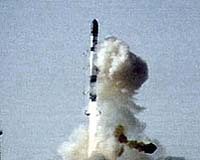
Washington (UPI) Dec 30, 2008 Russia's latest test launch of its long-troubled Bulava submarine-launched ballistic missile was another failure, and it was more costly than most as the Russian government had already approved the missile for full-scale production. On Dec. 25 four-star Army Gen. Nikolai Makarov, the chief of the Russian General Staff, announced that he believed production flaws were probably to blame for the test-launch failure Dec. 23. It was the fifth failure out of 10 Bulava test launches. This test failure was especially disappointing to the Russian navy and Strategic Missile Forces as it followed a highly successful test on Nov. 28 when a Bulava fired from the strategic nuclear-powered submarine Dmitry Donskoy in the White Sea hit a target 4,200 miles away in Kamchatka in Russia's Far East. "Either the military-industrial complex or production itself or design shortcomings could be to blame for the failure," Makarov stated, according to a report from RIA Novosti. In reality, of course, that meant that neither Makarov nor anyone else knew yet what went wrong. It will take a long and painstaking investigation to precisely confirm what the problem is. But already the evidence points to the same kind of systemic design problems that were responsible for other Bulava test-launch failures. "The launch was a failure," one official at the Belomorsk naval base told RIA Novosti. "The crew performed well. The missile left the tube, but went off course due to a malfunction after the first stage separation." A Navy commission will investigate the cause of the unsuccessful launch, Capt. 1st Rank Igor Dygalo, a Navy spokesman, announced, according to the RIA Novosti report. As we have previously reported in these columns, the Bulava SLBM is adapted from the successful and very reliable Topol-M intercontinental ballistic missile. However, the first stage of the Bulava had to be reduced in diameter so that it could fit in the somewhat smaller new so-called fifth-generation Borei class Project 955 Russian strategic nuclear submarines that are somewhat smaller than the old monster-sized Typhoon class made famous in the movie "The Hunt for Red October." The larger the nuclear-powered leviathan, the easier it would be for the modern generation of fast, quiet attack subs to detect, hunt down and kill. It was in making the reduced-diameter first stage of the Bulava SLBM reliable that the engineers at the Moscow Institute of Thermal Technology -- also referred to as the Moscow Institute of Heat Engineering -- ran into problems, for they had never built submarine-launched ballistic missiles before for the Russian navy. The Kremlin originally hoped that the Bulava could be operationally deployed in 2009. However, a senior Russian navy official told RIA Novosti in December that several more test launches would be needed throughout 2009 before the missile could be approved for regular service. RIA Novosti noted that each Bulava -- NATO designation SS-NX-30 -- is designed to have multiple independently targeted re-entry vehicles and to fly 5,000 miles. Russian Prime Minister Vladimir Putin has pledged that the Bulava will be the backbone of the submarine-based leg of Russia's air-, land- and sea-based nuclear "triad" deterrent through the first half of the 21st century. Therefore it cannot be allowed to fail. Share This Article With Planet Earth
Related Links Learn about nuclear weapons doctrine and defense at SpaceWar.com Learn about missile defense at SpaceWar.com All about missiles at SpaceWar.com Learn about the Superpowers of the 21st Century at SpaceWar.com
 Russia To Test-Launch At Least 5 Bulava ICBMs In 2009
 Moscow (RIA Novosti) Dec 28, 2008
The number of test launches for Russia's Bulava ICBM will be increased from three or four to at least five next year, a senior Navy official said on Tuesday. |
|
|

| The content herein, unless otherwise known to be public domain, are Copyright 1995-2007 - SpaceDaily.AFP and UPI Wire Stories are copyright Agence France-Presse and United Press International. ESA Portal Reports are copyright European Space Agency. All NASA sourced material is public domain. Additional copyrights may apply in whole or part to other bona fide parties. Advertising does not imply endorsement,agreement or approval of any opinions, statements or information provided by SpaceDaily on any Web page published or hosted by SpaceDaily. Privacy Statement |
 del.icio.us
 Digg
Digg Reddit
 YahooMyWeb
 Google
 Facebook