
 |
 |
 |
 |
 |
 |
 |
 |
 |

 |

Washington (AFP) May 24, 2011 Hail storms seem to arise out of nowhere, leaving those pummeled by the coin- to fist-sized ice balls to wonder how they came to be. US scientists said Tuesday that plant bacteria may be to blame. A Montana scientist collected some large hailstones measuring more than five centimeters (two inches) in diameter after a June storm last year, froze them, and later analyzed the water that melted away in layers. "Bacteria have been found within the embryo, the first part of a hailstone to develop," said Alexander Michaud of Montana State University in Bozeman, who presented the research at a meeting of microbiologists in New Orleans. "The embryo is a snapshot of what was involved with the event that initiated growth of the hailstone," said Michaud, a lead researcher in the field of bioprecipitation, the study of how bacteria may cause rain, snow and hail. In order for clouds to make ice, from which snow can fall, a particle must be present for the ice crystals to grow around, known as an ice nucleus. "In order for precipitation to occur, a nucleating particle must be present to allow for aggregation of water molecules," said Michaud. "There is growing evidence that these nuclei can be bacteria or other biological particles." A plant pathogen known as Psuedomonas syringae is commonly at the root of precipitation events, because its outer surface is so efficient at collecting water molecules around it, said Brent Christner of Louisiana State University. "Ice nucleating strains of P. syringae possess a gene that encodes a protein in their outer membrane that binds water molecules in an ordered arrangement," said Christner, who also presented research at the American Society for Microbiology in New Orleans. This provides "a very efficient nucleating template that enhances ice crystal formation," said Christner.
Share This Article With Planet Earth
Related Links Weather News at TerraDaily.com

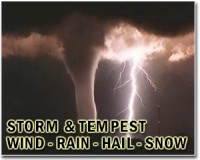 Grim search in ravaged US town as tornado kills 116
Joplin, Missouri (AFP) May 23, 2011 Rescue crews clawed through the rubble Monday searching for survivors after a tornado in Missouri killed 116 people, amid warnings that more powerful storms were bearing down on the area. "That's all that's left," said resident Roger Dedick as he pointed to a section of foundation, the remains of his home of 17 years in Joplin after the deadliest single tornado in six decades ripped through ... read more |
|
|
| The content herein, unless otherwise known to be public domain, are Copyright 1995-2010 - SpaceDaily. AFP and UPI Wire Stories are copyright Agence France-Presse and United Press International. ESA Portal Reports are copyright European Space Agency. All NASA sourced material is public domain. Additional copyrights may apply in whole or part to other bona fide parties. Advertising does not imply endorsement,agreement or approval of any opinions, statements or information provided by SpaceDaily on any Web page published or hosted by SpaceDaily. Privacy Statement |


 del.icio.us
 Digg
Digg Reddit
 YahooMyWeb
 Google
 Facebook


