
 |
 |
 |
 |
 |
 |
 |
 |
 |

 |
Bill Gates playfully frees swarm of mosquitoes
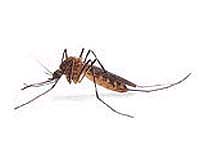
Long Beach, California (AFP) Feb 4, 2009 Microsoft founder turned disease-battling philanthropist Bill Gates on Wednesday loosed mosquitoes at an elite TED Conference to make a point about the deadly sting of malaria. "Malaria is spread by mosquitoes," Gates said while opening a jar onstage at a gathering known to attract technology kings, politicians, and Hollywood stars. "I brought some. Here I'll let them roam around. There is no reason only poor people should be infected." Gates waited a minute or so before assuring the audience the liberated insects were malaria-free. TED curator Chris Anderson fired back at the legendary computer software maker, joking that the headline for the video of his talk to be posted online at Ted.com would be "Gates releases more bugs into the world." As he has in travels on behalf of his eponymous charitable foundation, Gates detailed the strides made in dealing with malaria in affluent countries and the need to fight the disease in impoverished nations. "There is more money put into baldness drugs than into malaria," Gates quipped, triggering laughter. "Now, baldness is a terrible thing and rich men are afflicted. That is why that priority has been set." Gates called for aggressive distribution of insect netting and other gear proven to protect people from disease-transmitting stings. He also shared that a malaria vaccine backed by the Bill and Melinda Gates Foundation should start Phase Three testing in a few months. "I am an optimist; I think any tough problem can be solved," Gates said. "The market does not drive scientists, thinkers, or governments to do the right things. Only by paying attention and making people care can we make as much progress as we need to." Gates' clever candor continued as he filed a question from Anderson about the pall he felt shrouding the World Economic Forum in Davos, Switzerland, last month. "I think it is good that the mood in Davos was bleak," Gates said. "It was a great meeting where people really had to say 'Hi, how is your economy falling apart ... Gee that is different than how mine is ... What is your solution?'" Gates said he is confident the economy will recover, with new technologies playing vital roles, but that the financial meltdown was "a great checkpoint" compelling people to think realistically about money and business. "For me, it was a chance to make sure aid for the poorest doesn't get cut," Gates said of his time at Davos. His foundation plans to increase annual spending this year to 3.8 billion dollars despite its investment portfolio's value sinking. In a TED session titled "Reboot," Gates also called for vastly improving the quality of teachers at US schools because it will take "brilliant people" to solve the world's woes. "I hope I'm not in the Reboot session because you have to reboot your computers and associate that with me," Gates joked. "That might be fair, but don't think about it." Share This Article With Planet Earth
Related Links Epidemics on Earth - Bird Flu, HIV/AIDS, Ebola
 Surgical Implants Coated With One Of Nature's Antibiotics
 Vancouver, Canada (SPX) Feb 05, 2009
Researchers at the University of British Columbia have discovered a mimic of one of "nature's antibiotics" that can be used to coat medical devices to prevent infection and rejection. |
|
|

| The content herein, unless otherwise known to be public domain, are Copyright 1995-2007 - SpaceDaily.AFP and UPI Wire Stories are copyright Agence France-Presse and United Press International. ESA Portal Reports are copyright European Space Agency. All NASA sourced material is public domain. Additional copyrights may apply in whole or part to other bona fide parties. Advertising does not imply endorsement,agreement or approval of any opinions, statements or information provided by SpaceDaily on any Web page published or hosted by SpaceDaily. Privacy Statement |
 del.icio.us
 Digg
Digg Reddit
 YahooMyWeb
 Google
 Facebook