
 |
 |
 |
 |
 |
 |
 |
 |
 |

 |
Bizarre Bird Behavior Predicted By Game Theory
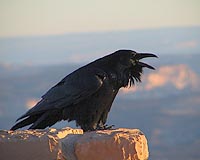
Exeter, UK (SPX) Feb 25, 2009 A team of scientists, led by the University of Exeter, has used game theory to explain the bizarre behaviour of a group of ravens. Juvenile birds from a roost in North Wales have been observed adopting the unusual strategy of foraging for food in 'gangs'. New research explains how this curious behaviour can be predicted by adapting models more commonly used by economists to analyse financial trends. This is the first time game theory has been used to successfully predict novel animal behaviour in the real world. The researchers believe this analysis could also shed light on the variation in feeding strategies in different populations in other species. Ravens feed on the carcasses of large animals. Most populations live in temperate forests, where individuals search for carcasses and finds are then defended by a pair of territorial adults. Unpaired younger birds, on the other hand, gather at communal roosts from which they search individually for carcasses on adult territories and recruit each other to overwhelm adult protectionism. However, at one raven roost on Anglesey, things work differently: juveniles forage in gangs. This level of coordination had not been seen before in a raven population. The researchers built a mathematical model to understand how this behaviour evolved and why it might occur in some roosts and not others. The model designed for this study was based on techniques used in other game theory models, which identify the most profitable behaviours of individuals in different situations to predict what would be favoured by evolution. The study revealed two strategies as being most profitable for ravens to find food. One is for birds to search independently for food and recruit each other. The other is for the birds to forage in gangs. The findings showed that gang foraging should occur when searching for food individually is no more efficient than foraging in groups. This is likely to be the case if the roost covers landscape that can be thoroughly explored by a gang over the course of a day. The deforested Welsh countryside offers just such conditions. The study also identifies the availability of food as a key factor. The roost in Anglesey is situated in an agricultural area, which means that the carcasses of farm animals are often available so food is more plentiful than in wild locations. When food is abundant, the opportunity for social advancement becomes more important. These ravens seem to be using foraging behaviour, not only to find food, but also to gain social status, which could help in other aspects of their lives, including finding a mate. Lead author Dr Sasha Dall of the University of Exeter said: "This is a rare example of how game theory has been used to predict behaviour in animals in the real world. Our study shows the potential for game theory to help biologists understand how different social structures and behaviours evolve in different environments and in response to human activities." Share This Article With Planet Earth
Related Links University of Exeter Darwin Today At TerraDaily.com
 Urban elephants ply Bangkok streets in search of tourist dollars
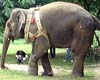 Bangkok (AFP) Feb 24, 2009
A drunken tourist staggers about as he repeatedly drops his bags of elephant feed on Bangkok's Soi Cowboy boulevard. |
|
|

| The content herein, unless otherwise known to be public domain, are Copyright 1995-2007 - SpaceDaily.AFP and UPI Wire Stories are copyright Agence France-Presse and United Press International. ESA Portal Reports are copyright European Space Agency. All NASA sourced material is public domain. Additional copyrights may apply in whole or part to other bona fide parties. Advertising does not imply endorsement,agreement or approval of any opinions, statements or information provided by SpaceDaily on any Web page published or hosted by SpaceDaily. Privacy Statement |
 del.icio.us
 Digg
Digg Reddit
 YahooMyWeb
 Google
 Facebook