
 |
 |
 |
 |
 |
 |
 |
 |
 |

 |
Black Holes Beat At The Hearts Of Galaxies
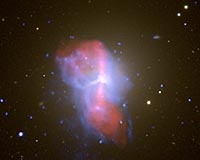
Ann Arbor MI (SPX) Nov 19, 2008 The powerful black holes at the center of massive galaxies and galaxy clusters act as hearts to the systems, pumping energy out at regular intervals to regulate the growth of the black holes themselves, as well as star formation, according to new data from NASA's Chandra X-Ray Observatory. Scientists from the University of Michigan, the Max-Planck Institute for Extraterrestrial Physics in Germany, the University of Maryland, Baltimore County (UMBC), the Harvard-Smithsonian Center for Astrophysics and Jacobs University in Germany contributed to the results. The gravitational pull of black holes is so strong that not even light can escape from them. Supermassive black holes with masses of more than a billion suns have been detected at the center of large galaxies. The material falling on the black holes causes sporadic or isolated bursts of energy, by which black holes are capable of influencing the fate of their host galaxies. The insight gained by this new research shows that black holes can pump energy in a gentler and rhythmic fashion, rather then violently. The scientists observed and simulated how the black hole at the center of elliptical galaxy M84 dependably sends bubbles of hot plasma into space, heating up interstellar space. This heat is believed to slow both the formation of new stars and the growth of the black hole itself, helping the galaxy remain stable. Interstellar gases only coalesce into new stars when the gas is cool enough. The heating is more efficient at the sites where it is most needed, the scientists say. Alexis Finoguenov, of UMBC and the Max-Planck Institute for Extraterrestrial Physics in Germany, compares the central black hole to a heart muscle. "Just like our hearts periodically pump our circulatory systems to keep us alive, black holes give galaxies a vital warm component. They are a careful creation of nature, allowing a galaxy to maintain a fragile equilibrium," Finoguenov said. This finding helps to explain a decades-long paradox of the existence of large amounts of warm gas around certain galaxies, making them appear bright to the Chandra X-ray telescope. "For decades astronomers were puzzled by the presence of the warm gas around these objects. The gas was expected to cool down and form a lot of stars," said Mateusz Ruszkowski, an assistant professor in the University of Michigan Department of Astronomy. "Now, we see clear and direct evidence that the heating mechanism of black holes is persistent, producing enough heat to significantly suppress star formation. These plasma bubbles are caused by bursts of energy that happen one after another rather than occasionally, and the direct evidence for such periodic behavior is difficult to find." The bubbles form one inside another, for a sort of Russian doll effect that has not been seen before, Ruszkowski said. One of the bubbles of hot plasma appears to be bursting and its contents spilling out, further contributing to the heating of the interstellar gas. "Disturbed gas in old galaxies is seen in many images that NASA's Chandra observatory obtained, but seeing multiple events is a really impressive evidence for persistent black hole activity," says Christine Jones, an astrophysicist at the Harvard-Smithsonian Center for Astrophysics. A paper on the research called "In-depth Chandra study of the AGN feedback in Virgo Elliptical Galaxy M84" has been published in Astrophysical Journal. Share This Article With Planet Earth
Related Links Chandra X-Ray Observatory Understanding Time and Space
 Colliding Galaxies Reveal Colossal Black Holes Common In Early Universe
 London, UK (SPX) Oct 17, 2008
New observations made with the Submillimeter Array of telescopes in Hawaii suggest that black holes - thought to exist in many, if not all, galaxies - were common even in the early Universe, when galaxies were just beginning to form. |
|
|

| The content herein, unless otherwise known to be public domain, are Copyright 1995-2007 - SpaceDaily.AFP and UPI Wire Stories are copyright Agence France-Presse and United Press International. ESA Portal Reports are copyright European Space Agency. All NASA sourced material is public domain. Additional copyrights may apply in whole or part to other bona fide parties. Advertising does not imply endorsement,agreement or approval of any opinions, statements or information provided by SpaceDaily on any Web page published or hosted by SpaceDaily. Privacy Statement |
 del.icio.us
 Digg
Digg Reddit
 YahooMyWeb
 Google
 Facebook