
 |
 |
 |
 |
 |
 |
 |
 |
 |

 |
Boeing Hardware To Bring ISS To Full Potential
Titusville FL (SPX) Mar 10, 2009 Space Shuttle Discovery is preparing to deliver the Starboard 6 (S6) truss segment built by Boeing - along with the segment's solar array wings and batteries - to the International Space Station (ISS) later this week. Shuttle mission STS-119, scheduled for a March 11 launch, marks the completion of the U.S. "core" of the station and delivery of the last major U.S., Boeing-built element. "The launch of the S6 truss payload is a key milestone for NASA and Boeing. This mission, adding the S6 and its solar arrays to ISS, is a major step toward making full use of this international, on-orbit research facility that I believe will deliver breakthrough science," said Brewster Shaw, vice president and general manager of Boeing Space Exploration. "The ISS is a great example of how NASA, industry, academia and the international partners have come together to achieve a common goal." With the addition of this fourth and final set of solar arrays, the station can produce 80 to100 kilowatts of power - about as much as 42 average homes. The addition will nearly double the amount of power available - from 15 to 30 kilowatts - to perform key scientific experiments on the station. The truss segment, a carbon copy of the Port 6 element already on orbit, also will include additional battery chargers. Installation of the S6 element completes the station's truss, the backbone of the ISS because of its importance in keeping the station functioning properly. Boeing assembled the 31,000-pound, 45-foot-long S6 truss segment and mated it to its solar arrays and batteries in the Space Station Processing Facility (SSPF) at NASA's Kennedy Space Center (KSC), Fla., where Boeing is the prime contractor for payload processing. The truss has had the longest time on the ground of any single ISS element - it arrived at KSC on Dec. 17, 2002 - with a Boeing team regularly maintaining it, cleaning it and inspecting it for corrosion. Boeing also provided the fluid support for ammonia operations used to cool the hardware's electrical components, placed the truss into its payload canister, and transported the element to the launch pad to await its delivery to the ISS. With help from Boeing, Discovery also will sport a special 6-by-6-inch tile under its wing that will test the airflow around the orbiter upon re-entry in response to a .25-inch by 4-inch protrusion. In addition, Discovery will include a modification designed by Boeing that enhances safety in the crew module by reducing the possibility of depressurization if an object strikes a partition wall on either side of the hatch. Share This Article With Planet Earth
Related Links Boeing Integrated Defense Systems Station at NASA Station and More at Roscosmos S.P. Korolev RSC Energia Watch NASA TV via Space.TV Space Station News at Space-Travel.Com
 Expedition 18 Ready To Take A Walk
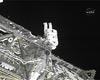 Houston TX (SPX) Mar 10, 2009
Aboard the orbiting International Space Station Monday, the Expedition 18 crew had a bit of down time. After Sunday's suited fit check of their Orlan spacesuits, Commander Mike Fincke and Flight Engineer Yury Lonchakov relaxed Monday in advance of their spacewalk slated to begin at 12:20 p.m. EDT Tuesday. Lonchakov, the lead spacewalker or EV 1, will wear the Orlan suit with the blue stripes. |
|
|

| The content herein, unless otherwise known to be public domain, are Copyright 1995-2007 - SpaceDaily.AFP and UPI Wire Stories are copyright Agence France-Presse and United Press International. ESA Portal Reports are copyright European Space Agency. All NASA sourced material is public domain. Additional copyrights may apply in whole or part to other bona fide parties. Advertising does not imply endorsement,agreement or approval of any opinions, statements or information provided by SpaceDaily on any Web page published or hosted by SpaceDaily. Privacy Statement |

 del.icio.us
 Digg
Digg Reddit
 YahooMyWeb
 Google
 Facebook