
 |
 |
 |
 |
 |
 |
 |
 |
 |

 |

London, UK (SPX) Nov 08, 2010 Was it the evolution of the hand, or of the brain, that enabled prehistoric toolmakers to make the leap from simple flakes of rock to a sophisticated hand axe? A new study finds that the ability to plan complex tasks was key. The research, published in the Public Library of Science journal PLoS ONE, is the first to use a cyber data glove to precisely measure the hand movements of stone tool making, and compare the results to brain activation. "Making a hand axe appears to require higher-order cognition in a part of the brain commonly known as Broca's area," said Emory anthropologist Dietrich Stout, co-author of the study. It's an area associated with hierarchical planning and language processing, he noted, further suggesting links between tool-making and language evolution. "The leap from stone flakes to intentionally shaped hand axes has been seen as a watershed in human prehistory, providing our first evidence for the imposition of preconceived, human designs on the natural world," he said. Stout is an experimental archeologist who recreates prehistoric tool making to study the evolution of the human brain and mind. Subjects actually knap tools from stone as activity in their brains is recorded. "Changes in the hand and grip were probably what made it possible to make the first stone tools," Stout said. "Increasingly we're finding that the earliest tools required visual and motor skills, but were conceptually simple." For this study, Stout used a data glove to record the exact hand postures of the research subject across a range of prehistoric technologies. He teamed with Aldo Faisal, a neuroscientist at Imperial College London, and archeologists Jan Apel of Gotland University College in Sweden and Bruce Bradley of Exeter University in Devon, England. The researchers compared the manual dexterity for the tasks involved in making two types of tools: Oldowan flakes and Late Acheulean hand axes. Simple Oldowan stone flakes are the earliest known tools, dating back 2.6 million years. The Late Acheulean hand axe, going back 500,000 years, embodies a higher level of refinement and standardization. "I assumed that the manual dexterity was going to be greater for making the hand axe," Stout said. "But we found that the hand gestures were so similar that we couldn't distinguish them." A previous study by Stout found differences in the brain activation associated with Oldowan versus Acheulean technologies. It was unclear, however, whether the difference was due to higher-level behavior organization or lower-level differences in manipulative complexity. The results of the data glove study point to higher cognition. "The advances of Late Acheulean technology were not about increased dexterity. They were about the ability to plan complex action sequences," Stout said. A hand axe requires the maker to begin with a precise, symmetrical end in mind. A variety of tools are involved, from a large rock to rough out the basic shape of the axe, to a softer implement, such as an antler billet, to thin and sharpen the edges. The ongoing research could lead to new understanding of the modern human brain. "For the past two million years, stone tool-making has been the most common and consistent human technology, done by virtually every society," Stout said. "It's an important human behavior that probably helped shape our brains."
Share This Article With Planet Earth
Related Links Emory University All About Human Beings and How We Got To Be Here

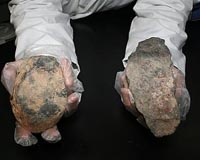 Stone Age Humans Needed Bigger Brains For Better Tool Design
London, UK (SPX) Nov 05, 2010 Stone Age humans were only able to develop relatively advanced tools after their brains evolved a greater capacity for complex thought, according to a new study that investigates why it took early humans almost two million years to move from razor-sharp stones to a hand-held stone axe. Researchers used computer modelling and tiny sensors embedded in gloves to assess the complex hand skills ... read more |
|
|
| The content herein, unless otherwise known to be public domain, are Copyright 1995-2010 - SpaceDaily. AFP and UPI Wire Stories are copyright Agence France-Presse and United Press International. ESA Portal Reports are copyright European Space Agency. All NASA sourced material is public domain. Additional copyrights may apply in whole or part to other bona fide parties. Advertising does not imply endorsement,agreement or approval of any opinions, statements or information provided by SpaceDaily on any Web page published or hosted by SpaceDaily. Privacy Statement |


 del.icio.us
 Digg
Digg Reddit
 YahooMyWeb
 Google
 Facebook


