
 |
 |
 |
 |
 |
 |
 |
 |
 |

 |
Brazil Begins Mechanical Tests On Satellites
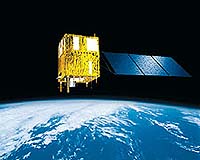
Rio De Janeiro (XNA) Dec 30, 2008 Brazil's National Institute of Space Investigations (INPE) has begun additional tests on two satellites that are expected to be launched in five years as part of a joint program with China. The INPE announced on its web site Sunday that scientists are testing dynamic resistance, sine-wave and acoustic vibrations on the satellites of the Chinese-Brazilian Remote Vigilance Program (CBERS). The tests are being conducted in the INPE labs in the southern city of Sao Jose dos Campos. The satellites CBERS-3 and CBERS-4 are scheduled to be launched in 2010 and 2013 respectively. The CBERS program was established in 1988 to allow China and Brazil to develop, build, launch and operate satellites together. The first satellite, CBERS-1, was launched in 1999 and operated for four years till August 2003. A second one, CBERS-2, was launched in 2003, and fulfilled its five-year mission in orbit on Oct. 22. CBERS-2B, the third of its kind, was launched on Sept. 19,2007. The CBERS is currently part of the world's main Earth-observing mission program that includes the U.S. Landsat, the French Spot and the Indian Resource Sat. Brazil uses satellite images to monitor the deforestation of the Amazons and to get agricultural information. Brazil this year also started to provide free satellite images to Latin American and African countries.
Source: Xinhua News Agency Share This Article With Planet Earth
Related Links - Space Technology News - Applications and Research
 Space Foundation Recognizes Three GMV Products As Certified Space Technologies
 Colorado Springs CO (SPX) Dec 10, 2008
The Space Foundation welcomed insightArthroVR, Moviloc, and SAGRAN, three of GMV's many space-based products, as Certified Space Technologies. |
|
|

| The content herein, unless otherwise known to be public domain, are Copyright 1995-2007 - SpaceDaily.AFP and UPI Wire Stories are copyright Agence France-Presse and United Press International. ESA Portal Reports are copyright European Space Agency. All NASA sourced material is public domain. Additional copyrights may apply in whole or part to other bona fide parties. Advertising does not imply endorsement,agreement or approval of any opinions, statements or information provided by SpaceDaily on any Web page published or hosted by SpaceDaily. Privacy Statement |
 del.icio.us
 Digg
Digg Reddit
 YahooMyWeb
 Google
 Facebook