
 |
 |
 |
 |
 |
 |
 |
 |
 |

 |
British woman does 314-foot ocean dive
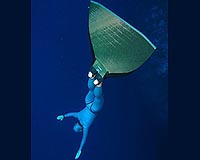
Miami, April 3, 2009 A 37-year-old British woman has regained her title in the extreme sport of freediving with a 314-foot plunge beneath the surface of the Atlantic Ocean. Sara Campbell, known to her fans as "part woman, part fish," pushed the boundaries of human endurance to new levels in an underwater cavern in the Bahamas Thursday night. She went deeper than any female freediver before her without special gear, then shot back to the surface, all while holding her breath for 3 minutes, 36 seconds. "The dive felt great and I'm just feeling fantastic," she told the Times of London. "At one point I started feeling negative thoughts -- 'Do I really want to do this?' - but then I told myself not to be ridiculous, just get it done, go for the bottom." Campbell's crown came in the constant-weight discipline competition which requires freedivers to descend and return using only the power of their own bodies and a mermaid-like fin attached to their feet. Campbell, known also as "mighty mouse" for her 4 foot, 11-inch frame, regained the title she won two years ago - she broke three records in 48 hours while still a novice -- then dropped out of the 2008 competition when her mother died. Doctors have studied the yoga instructor from South London for her unusual ability and found her lungs to be 25 percent larger than an average person of her size and weight, allowing her to pack more air into her system before she descends. Share This Article With Planet Earth
Related Links All About Human Beings and How We Got To Be Here
 Americans spend eight hours a day in front of screens
 Washington (AFP) March 27, 2009
Adult Americans spend an average of more than eight hours a day in front of screens -- televisions, computer monitors, cellphones or other devices, according to a new study. |
|
|

| The content herein, unless otherwise known to be public domain, are Copyright 1995-2007 - SpaceDaily.AFP and UPI Wire Stories are copyright Agence France-Presse and United Press International. ESA Portal Reports are copyright European Space Agency. All NASA sourced material is public domain. Additional copyrights may apply in whole or part to other bona fide parties. Advertising does not imply endorsement,agreement or approval of any opinions, statements or information provided by SpaceDaily on any Web page published or hosted by SpaceDaily. Privacy Statement |
 del.icio.us
 Digg
Digg Reddit
 YahooMyWeb
 Google
 Facebook