
 |
 |
 |
 |
 |
 |
 |
 |
 |

 |

Berkeley CA (SPX) Mar 25, 2011 The debate surrounding carbon capture and storage intensifies as scientists from the Earth Sciences Division at the Lawrence Berkeley National Laboratory (Berkeley Lab) examine the capacity for storing carbon dioxide underground, in a study published in the new journal Greenhouse Gases: Science and Technology. The study debates some of the conclusions drawn in an earlier study by Ehlig-Economides and Economides1, countering their claims that carbon dioxide cannot feasibly be stored underground. These earlier findings, according to the Berkeley Lab researchers, only considered closed-system subsurface formations, with limited mechanisms for relieving the pressure. Carbon capture and storage (CCS) is controversial in the eyes of the general public. Pressure build-up in the subsurface induced by the injection of carbon dioxide from industrial-scale projects is a key constraint for the amount of carbon dioxide that can be safely stored underground. In their paper, the Berkeley Lab researchers considered a full-scale deployment scenario in which enough carbon dioxide is stored to make relevant contributions to climate change mitigation. Modeling studies illustrating the scale and magnitude of pressure build-up are presented for hypothetical CCS projects in two representative basins currently being investigated for future deployment of carbon dioxide storage in the US. According to lead researcher Dr. Quanlin Zhou, although large-scale pressure build-up may have a limiting effect on storage capacity, it is not as significant as claimed previously by Ehlig-Economides and Economides. Dr. Zhou and fellow researcher Dr. Jens Birkholzer considered three different types of storage reservoirs: closed, partially closed and open. They indicate that the storage of carbon dioxide deep underground will occur mainly in partially closed or open formations, where pressure build-up is relieved naturally by movement of native saline waters into regions far away from where carbon dioxide injection occurs. The authors conclude that CCS can still be considered as a practical means of mitigating carbon dioxide emissions as there is more capacity to store carbon dioxide underground than suggested in the study of Ehlig-Economides and Economides. The study also concludes that pressure management strategies may feasibly be undertaken to relieve a pressurized system. "This investigation furthers our understanding of the extent and magnitude of pressure build-up induced by large-scale underground carbon storage," said Dr. Zhou. "Using natural open and partially open formations will help attenuate such pressure build-up to a manageable degree." [1] Ehlig-Economides C and Economides MJ. Sequestering carbon dioxide in a closed underground volume. J Petrol Sci Eng 70, 123-130 (2010)
Share This Article With Planet Earth
Related Links - Carbon Worlds - where graphite, diamond, amorphous, fullerenes meet

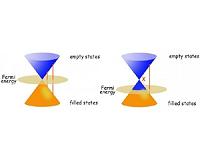 Berkeley Lab Scientists Control Light Scattering In Graphene
Berkeley CA (SPX) Mar 22, 2011 Scientists at the U.S. Department of Energy's Lawrence Berkeley National Laboratory (Berkeley Lab) and the University of California at Berkeley have learned to control the quantum pathways determining how light scatters in graphene. Controlled scattering provides a new tool for the study of this unique material - graphene is a single sheet of carbon just one atom thick - and may point to practic ... read more |
|
|
| The content herein, unless otherwise known to be public domain, are Copyright 1995-2010 - SpaceDaily. AFP and UPI Wire Stories are copyright Agence France-Presse and United Press International. ESA Portal Reports are copyright European Space Agency. All NASA sourced material is public domain. Additional copyrights may apply in whole or part to other bona fide parties. Advertising does not imply endorsement,agreement or approval of any opinions, statements or information provided by SpaceDaily on any Web page published or hosted by SpaceDaily. Privacy Statement |


 del.icio.us
 Digg
Digg Reddit
 YahooMyWeb
 Google
 Facebook


