|
|
|
|
|
|
|
|
|
|
|


| . |  |
. |
|
|
|
 by Alan Stern, PI New Horizons Boulder CO (SPX) Apr 21, 2015
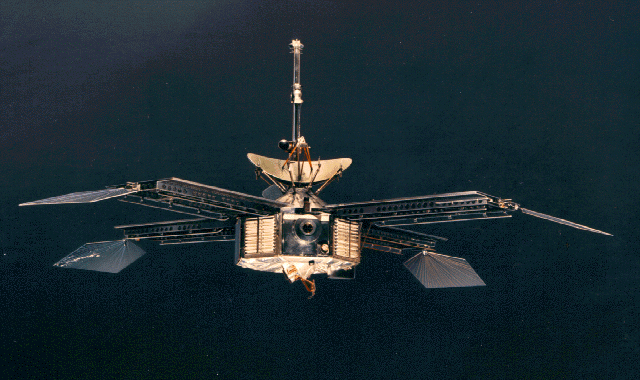
New Horizons remains healthy and on course for its prime Pluto system science in July! On July 14, New Horizons will make its closest approach to Pluto and its system of moons. In a cosmic coincidence, that will occur 50 years to the day after the historic first flyby of Mars, on July 14, 1965! It's amazing - in less than one human lifetime, from innermost Mercury to outermost Pluto - all nine classical planets of our solar system will have been explored. Equally amazing, NASA spacecraft have led the way: from the very first such flyby of Venus in 1962, to the New Horizons flyby of Pluto in 2015, NASA has been first to every one of those planets. Carl Sagan used to say that there would only be one or two generations of humans who would share that special moment in time, who as children know the planets only as points of light but as adults know them all as places, imaged and studied - real worlds that have become part of human experience. I am proud that the upcoming exploration of the Pluto system in July will be the very capstone to that historic era of exploration, completing the initial reconnaissance of the planets. And I am happy that you will be a part of that capstone moment. Just last week the mission began what we call Approach Phase 2. Approach Phase 1, which began in January, was primarily designed to obtain navigation images to home in on Pluto, and data on the space environment where Pluto orbits. Approach Phase 1 concluded April 4, having been performed flawlessly. It included intensive imaging of Pluto and satellites Nix and Charon as dots in the distance to measure their positions against star fields to refine our navigation to Pluto, and the collection of space plasma and dust data to characterize the environment near Pluto. Approach Phase 2 (AP2), which will last until mid-June, is different. Although we will continue to collect navigation data to home in on Pluto, and environmental data about the space around Pluto, we now turn our attention to the study of the Pluto system itself. During the next two months, we'll be collecting higher and higher resolution imagery, including both black-and-white and color images, as well as infrared and ultraviolet spectra to learn new things about the composition of Pluto and its moons. In fact, our highest-resolution imager, LORRI, will begin returning images better than any obtained from Earth or Earth-orbit by mid-May - that's next month! By the end of AP2, these images will have about 10 times as many pixels on Pluto as the best images available today. Other key events in AP2 include a major test of our radio science experiment, REX, which will probe Pluto's atmosphere and measure its temperature and radar reflectivity in July, and possibly two engine burns to trim our trajectory as we navigate toward our precise aim point near Pluto. Also in AP2, the mission team will participate in our last two mission simulations: one for hazard avoidance and one for science data processing. And the science team will meet in late May to finalize its plans for approach and encounter. As the pace of events heats up you'll be seeing more in the way of image and news releases, so stay tuned. In fact, on the afternoon of April 14, NASA will hold a pair of televised events including our team and NASA leadership, so press and public can learn more about our detailed objectives and flyby plans for the exploration of Pluto and its moons. This event will be available live on the Web at www.nasa.gov, and anyone can tune in! By the time I next write, in May, we'll be deep in Approach Phase 2 and on the verge of the fast-paced, historic events of June and July that will reveal Pluto and its moons "for all mankind." Well, that's it for now. Until I write again, I hope you'll keep exploring - just as we do.
Related Links New Horizons at APL The million outer planets of a star called Sol
|
|
| ||||||||||||||||||||
| The content herein, unless otherwise known to be public domain, are Copyright 1995-2014 - Space Media Network. All websites are published in Australia and are solely subject to Australian law and governed by Fair Use principals for news reporting and research purposes. AFP, UPI and IANS news wire stories are copyright Agence France-Presse, United Press International and Indo-Asia News Service. ESA news reports are copyright European Space Agency. All NASA sourced material is public domain. Additional copyrights may apply in whole or part to other bona fide parties. Advertising does not imply endorsement, agreement or approval of any opinions, statements or information provided by Space Media Network on any Web page published or hosted by Space Media Network. Privacy Statement All images and articles appearing on Space Media Network have been edited or digitally altered in some way. Any requests to remove copyright material will be acted upon in a timely and appropriate manner. Any attempt to extort money from Space Media Network will be ignored and reported to Australian Law Enforcement Agencies as a potential case of financial fraud involving the use of a telephonic carriage device or postal service. |


 del.icio.us
 Digg
Digg Reddit
 Google