
 |
 |
 |
 |
 |
 |
 |
 |
 |

 |

Pasadena, Calif. (UPI) Feb 9, 2011 A car-size asteroid will pass near Earth Wednesday, U.S. scientists said, while one bigger than two football fields might hit Earth in 18 years. The 2011 CA7 asteroid, measuring 9 1/2 feet across, will be 64,300 miles overhead Wednesday, reaching its closest point around 2:25 p.m. EST, said NASA's Jet Propulsion Laboratory in Pasadena, Calif. A 4-foot-wide asteroid called 2011 CQ 1 sailed 3,400 miles above Earth Friday, the National Aeronautics and Space Administration said. Both asteroids are so small that even if they did get pulled to Earth, they would not survive the fiery trip to the surface and would break up or burn up on the way down, Space.com said. By contrast, an asteroid larger than two football fields could strike Earth April 13, 2036, Russian scientists said, contradicting NASA scientists, who said in 2009 the 99942 Apophis asteroid had nearly no chance of hitting Earth on that date. Apophis, which NASA scientists also said has a 2.7 percent change of smashing into Earth in 2029, will get as close to Earth as about 23,000 miles April 13, 2029 -- and "its likely collision with Earth may occur on April 13, 2036," Professor Leonid Sokolov of St. Petersburg State University said. Still, the chance of a collision is extremely slim because scientists will develop ways of preventing it, Sokolov said. "Our task is to consider various alternatives and develop scenarios and plans of action depending on the results of further observations of Apophis," Sokolov told Russian state-owned news agency RIA Novosti. Sokolov and his colleagues are "technically" correct, Donald Yeomans, head of NASA's Near-Earth Object Program Office, told The Christian Science Monitor. "There is a chance (of a collision) in 2036," but the chance is 1 in 250,000, he said. The Russian calculations are based on the 900-foot Apophis traveling through a "gravitational keyhole" as it passes Earth in 2029. The gravitational keyhole is a precise region in space, about 2,000 feet across, in which Earth's gravity could tweak Apophis's path and set it up for the April 13, 2036, impact, scientists from both countries said. "If it goes through what we call a keyhole during that close Earth approach (in 2029) ... then it will indeed be perturbed just right so that it will come back and smack Earth on April 13, 2036," Yeomans said. But the chances the asteroid will go through the keyhole are "minuscule," he told the newspaper. And scientists are working to minimize the chances even further. Apophis will make a fairly close approach to Earth late next year and in early 2013, Yeomans said. And if the asteroid seems headed on a destructive path, NASA will devise a scheme and the machinery needed to change its orbit, decreasing the probability of a 2036 collision to zero, Yeomans said.
Share This Article With Planet Earth
Related Links Asteroid and Comet Mission News, Science and Technology

 Asteroid Busting
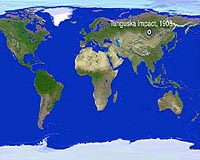
Bethesda MD (SPX) Feb 08, 2011 Imagine it is June 30, 1908 and you are in Siberia. The time is just after seven in the morning. Suddenly a pressure wave knocks you off your feet and a few moments later a blast of heat is so intense that you think your shirt is on fire. This is what a witness felt some 40 miles away from ground zero in the Tunguska event, over 100 years ago. This is the only recorded entry of a large natural s ... read more |
|
|
| The content herein, unless otherwise known to be public domain, are Copyright 1995-2010 - SpaceDaily. AFP and UPI Wire Stories are copyright Agence France-Presse and United Press International. ESA Portal Reports are copyright European Space Agency. All NASA sourced material is public domain. Additional copyrights may apply in whole or part to other bona fide parties. Advertising does not imply endorsement,agreement or approval of any opinions, statements or information provided by SpaceDaily on any Web page published or hosted by SpaceDaily. Privacy Statement |


 del.icio.us
 Digg
Digg Reddit
 YahooMyWeb
 Google
 Facebook


