
 |
 |
 |
 |
 |
 |
 |
 |
 |

 |

Gainesville FL (SPX) Aug 31, 2010 A new University of Florida study indicates extinct carnivorous mammals shrank in size during a global warming event that occurred 55 million years ago. The study, scheduled to appear in the December print edition of the Journal of Mammalian Evolution and now available online, describes a new species that evolved to half the size of its ancestors during this period of global warming. The hyena-like animal, Palaeonictis wingi, evolved from the size of a bear to the size of a coyote during a 200,000-year period when Earth's average temperature increased about 15 degrees Fahrenheit. Following this global warming event, Earth's temperature cooled and the animal evolved to a larger size. "We know that plant-eating mammals got smaller during the earliest Eocene when global warming occurred, possibly associated with elevated levels of carbon dioxide," said lead author Stephen Chester, a Yale University doctoral student who began the research at UF with Jonathan Bloch, curator of vertebrate paleontology at the Florida Museum of Natural History. "Surprisingly, this study shows that the same thing happened in some carnivores, suggesting that other factors may have played a critical role in their evolution." Researchers discovered a nearly complete jaw from the animal in Wyoming's Big Horn Basin in 2006 during a fossil-collecting expedition, led by Bloch, a co-author on the study. Bloch said the new findings could help scientists better understand the impact of current global warming. "Documenting the impact of global climate change in the past is one of the only real experiments that can inform us about what the effects global warming might have on mammals in the near future," said Bloch, who has studied this climate change event for nearly a decade. Scientists think the Earth experienced increased levels of carbon dioxide and a drier environment during the warmer time period, but they do not completely understand what caused mammals to shrink. One theory is that carbon dioxide levels reduced plant nutrients, causing herbivorous mammals to shrink. The newly described species primarily consumed meat, meaning plant nutrients couldn't have been the only factor, Bloch said. Mammals in warmer climates today tend to be smaller than mammals in colder climates, Chester said. For example, brown bears in Montana are generally smaller than those found in Alaska. The study's other authors are Ross Secord, assistant professor at the University of Nebraska, and Doug Boyer, assistant professor at Brooklyn College. Bloch said a tooth from this animal was described in a paper about 20 years ago, but scientists did not have enough information to name the new species until finding the jaw. The species was named after Scott Wing, a paleobotanist at the Smithsonian National Museum of Natural History. He studies the impact the global warming event had on forests in the past, and has played an important role in the collaborative research in the Big Horn Basin, Bloch said.
Share This Article With Planet Earth
Related Links University of Florida Darwin Today At TerraDaily.com

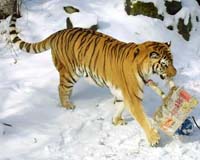 China, Russia to set up cross-border tiger protection zone
Beijing (AFP) Aug 30, 2010 China and Russia have agreed to set up the first cross-border protection zone for Siberian tigers, as they try to boost efforts to save the endangered species, state media reported Monday. The zone will straddle China's northeastern province of Jilin and Russia's Primorsky Krai region, and authorities in both countries will launch an anti-poaching campaign along the border, the China Daily n ... read more |
|
|
| The content herein, unless otherwise known to be public domain, are Copyright 1995-2010 - SpaceDaily. AFP and UPI Wire Stories are copyright Agence France-Presse and United Press International. ESA Portal Reports are copyright European Space Agency. All NASA sourced material is public domain. Additional copyrights may apply in whole or part to other bona fide parties. Advertising does not imply endorsement,agreement or approval of any opinions, statements or information provided by SpaceDaily on any Web page published or hosted by SpaceDaily. Privacy Statement |


 del.icio.us
 Digg
Digg Reddit
 YahooMyWeb
 Google
 Facebook


