
 |
 |
 |
 |
 |
 |
 |
 |
 |

 |
Cassini Finds Hyrocarbon Rains May Fill Titan Lakes
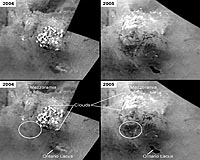
Boulder CO (SPX) Jan 30, 2009 Recent images of Titan from NASA's Cassini spacecraft affirm the presence of lakes of liquid hydrocarbons by capturing changes in the lakes brought on by rainfall. For several years, Cassini scientists have suspected that dark areas near the north and south poles of Saturn's largest satellite might be liquid-filled lakes. An analysis published in the journal Geophysical Research Letters of recent pictures of Titan's south polar region reveals new lake features not seen in images of the same region taken a year earlier. The presence of extensive cloud systems covering the area in the intervening year suggests that the new lakes could be the result of a large rainstorm and that some lakes may thus owe their presence, size and distribution across Titan's surface to the moon's weather and changing seasons. The high-resolution cameras of Cassini's Imaging Science Subsystem (ISS) have now surveyed nearly all of Titan's surface at a global scale. An updated Titan map, just released by the Cassini Imaging Team, includes the first near-infrared images of the leading hemisphere portion of Titan's northern "lake district" captured on Aug. 15-16, 2008. These ISS images complement existing high-resolution data from Cassini's Visible and Infrared Mapping Spectrometer (VIMS) and RADAR instruments. The leading hemisphere of a moon is that which always points in the direction of motion as the moon orbits the planet. Such observations have documented greater stores of liquid methane in the northern hemisphere than in the southern hemisphere. And, as the northern hemisphere moves toward summer, Cassini scientists predict large convective cloud systems will form there and precipitation greater than that inferred in the south could further fill the northern lakes with hydrocarbons. Some of the north polar lakes are large. If full, Kraken Mare - at 400,000 square kilometers - would be almost five times the size of North America's Lake Superior. All the north polar dark 'lake' areas observed by ISS total more than 510,000 square kilometers - almost 40 percent larger than Earth's largest "lake," the Caspian Sea. However, evaporation from these large surface reservoirs is not great enough to replenish the methane lost from the atmosphere by rainfall and by the formation and eventual deposition on the surface of methane-derived haze particles. "A recent study suggested that there's not enough liquid methane on Titan's surface to resupply the atmosphere over long geologic timescales," said Dr. Elizabeth Turtle, Cassini imaging team associate at the Johns Hopkins University Applied Physics Lab in Laurel, Md., and lead author of this paper. "Our new map provides more coverage of Titan's poles, but even if all of the features we see there were filled with liquid methane, there's still not enough to sustain the atmosphere for more than 10 million years." Combined with previous analyses, the new observations suggest that underground methane reservoirs must exist. Titan is the only satellite in the solar system with a thick atmosphere in which a complex organic chemistry occurs. "It's unique," Turtle said. "How long Titan's atmosphere has existed or can continue to exist is still an open question." That question and others related to the moon's meteorology and its seasonal cycles may be better explained by the distribution of liquids on the surface. Scientists also are investigating why liquids collect at the poles rather than low latitudes, where dunes are common instead. "Titan's tropics may be fairly dry because they only experience brief episodes of rainfall in the spring and fall as peak sunlight shifts between the hemispheres," said Dr. Tony DelGenio of NASA's Goddard Institute for Space Studies in New York, a co-author and a member of the Cassini imaging team. "It will be interesting to find out whether or not clouds and temporary lakes form near the equator in the next few years." Titan and the transformations on its surface brought about by the changing seasons will continue to be a major target of investigation throughout Cassini's Equinox mission. Share This Article With Planet Earth
Related Links Cassini Images Explore The Ring World of Saturn and her moons Jupiter and its Moons The million outer planets of a star called Sol News Flash at Mercury
 Titan's Ethane Lake
 Moffett Field CA (SPX) Aug 05, 2008
Scientists have confirmed that at least one body in our solar system, other than Earth, has a surface liquid lake. |
|
|

| The content herein, unless otherwise known to be public domain, are Copyright 1995-2007 - SpaceDaily.AFP and UPI Wire Stories are copyright Agence France-Presse and United Press International. ESA Portal Reports are copyright European Space Agency. All NASA sourced material is public domain. Additional copyrights may apply in whole or part to other bona fide parties. Advertising does not imply endorsement,agreement or approval of any opinions, statements or information provided by SpaceDaily on any Web page published or hosted by SpaceDaily. Privacy Statement |
 del.icio.us
 Digg
Digg Reddit
 YahooMyWeb
 Google
 Facebook