
 |
 |
 |
 |
 |
 |
 |
 |
 |

 |

Cleveland OH (SPX) Mar 25, 2011 Catalysts made of carbon nanotubes dipped in a polymer solution equal the energy output and otherwise outperform platinum catalysts in fuel cells, a team of Case Western Reserve University engineers has found. The researchers are certain that they'll be able to boost the power output and maintain the other advantages by matching the best nanotube layout and type of polymer. But already they've proved the simple technique can knock down one of the major roadblocks to fuel cell use: cost. Platinum, which represents at least a quarter of the cost of fuel cells, currently sells for about $65,000 per kilogram. These researchers say their activated carbon nanotubes cost about $100 per kilogram. Their work is published in the online edition of Journal of the American Chemical Society "This is a breakthrough," said Liming Dai, a professor of chemical engineering and the research team leader. Dai and research associates Shuangyin Wang and Dingshan Yu found that by simply soaking carbon nanotubes in a water solution of the polymer polydiallyldimethylammoniumn chloride for a couple of hours, the polymer coats the nanotube surface and pulls an electron partially from the carbon, creating a net positive charge. They placed the nanotubes on the cathode of an alkaline fuel cell. There, the charged material acts as a catalyst for the oxygen-reduction reaction that produces electricity while electrochemically combining hydrogen and oxygen. In testing, the fuel cell produced as much power as an identical cell using a platinum catalyst. But the activated nanotubes last longer and are more stable, the researchers said. Unlike platinum, the carbon-based catalyst: doesn't lose catalytic activity and, therefore, efficiency, over time; isn't fouled by carbon monooxide poising; and is free from the crossover effect with methanol. Methanol, a liquid fuel that's easier to store and transport than hydrogen, reduces activity of a platinum catalyst when the fuel crosses over from the anode to the cathode in a fuel cell. The new process builds on the Dai lab's earlier work using nitrogen-doped carbon nanotubes as a catalyst. In that process, nitrogen, which was chemically bonded to the carbon, pulled electron partially from the carbon to create a charge. Testing showed the doped tubes tripled the energy output of platinum. Dai said the new process is far simpler and cheaper than using nitrogen-doped carbon nanotubes and he's confident his lab will increase the energy output as well. "We have not optimized the system yet."
Share This Article With Planet Earth
Related Links Case Western Reserve University Space Technology News - Applications and Research

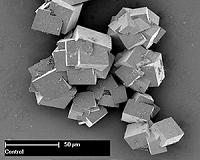 'Seeding' The Next Gen Of Smart Materials
Canberra, Australia (SPX) Mar 24, 2011 Scientists at CSIRO have developed a simple but effective technique for growing and adding value to an exciting new group of smart materials which could be used in areas such as optical sensing and drug storage and delivery. Working with a team of international collaborators, Dr Paolo Falcaro and Dr Dario Buso from CSIRO's Future Manufacturing Flagship have developed a revolutionary way to ... read more |
|
|
| The content herein, unless otherwise known to be public domain, are Copyright 1995-2010 - SpaceDaily. AFP and UPI Wire Stories are copyright Agence France-Presse and United Press International. ESA Portal Reports are copyright European Space Agency. All NASA sourced material is public domain. Additional copyrights may apply in whole or part to other bona fide parties. Advertising does not imply endorsement,agreement or approval of any opinions, statements or information provided by SpaceDaily on any Web page published or hosted by SpaceDaily. Privacy Statement |


 del.icio.us
 Digg
Digg Reddit
 YahooMyWeb
 Google
 Facebook


