
 |
 |
 |
 |
 |
 |
 |
 |
 |

 |
China, Japan Build Sharp Eyes For Further Space Observations
Beijing (XNA) Feb 11, 2009 China and Japan are making prominent contributions to a cutting-edge East Asian radio telescope network by respectively building the world's top-level radio telescope apparatus to be dedicated to further observations into the galaxy and black holes. FAST, short for the Five-hundred-meter Aperture Spherical Radio Telescope, is the world's largest-aperture radio telescope announced so far and is under construction in a karst-landform village of southwestern China's Guizhou Province. Japanese astronomers, meanwhile, are planning to launch the second generation of its world leading space radio telescope program called VSOP-2 which allows satellites to carry antennae into the space and therefore, expands the telescope network to beyond the earth's surface. Mark J. Reid, astronomer at the Harvard-Smithsonian Center for Astrophysics in the United States, told Xinhua in an email Tuesday, the two apparatus would help East Asian astronomers play a large role in the venture of space exploration. "The huge FAST telescope will ultimately allow detection of fainter sources of celestial bodies," Reid wrote, "and the Japanese space antennae will yield the highest angular resolution possible." Due to be completed in 2013, FAST could be used to study physical laws of objects under extreme conditions and help search for extraterrestrial civilizations by identifying possible interplanetary communication signals, official website of the project said. Japan's VSOP-2, second generation of the VLBI (Very Long Baseline Interferometry) Space Observatory Program scheduled to launch in 2012, would further expand the baselines between the telescopes. Armed with other advantages over the first generation such as higher observing frequencies and increased bandwidths, the VSOP-2 would gain higher resolution and sensitivity. Radio telescopes differ from optical ones in that they use radio antennae to track and collect data from satellites and space probes. The VLBI technology used in radio telescopes combines the observations simultaneously made by several telescopes to expand the diameter and increase magnification. The two apparatus, to be included in a large radio telescope network called the East Asia VLBI consortium, could each cooperate with the radio telescopes stationed on earth. The consortium, whose full-scale observations are expected to start in 2010, consists of 19 radio telescopes from China, Japan and the Republic of Korea (ROK) that cover an area with a diameter of 6,000 kilometers from northern Japan's Hokkaido to western China's Kunming and Urumqi. China's four telescopes participating in the consortium are still focusing on tracking Chang'e-1, China's first lunar probe, said Shen Zhiqiang, a VLBI researcher at the Shanghai Astronomical Observatory. "But we are carrying out experimental observation tests as much as possible to prepare for the cooperation with Japan and ROK," Shen said. The Korean side, with three telescopes to join the network, is working with the Japanese on building a correlator to be put in use by end of next year in Seoul. Se-Hyung Cho, initiator of the Korean VLBI Network (KVN), told Xinhua in an email, the correlator combines the observed data from each station of the East Asia VLBI consortium for synthesized high-resolution images. Korean astronomers will design their observational study based on available "spatial resolutions and sensitivities" - ability to obtain clear images of the observed object, of the East Asia VLBI network, Cho wrote. The first radio antenna used to identify astronomical radio sources was built by Karl Guthe Jansky, an engineer with Bell Telephone Laboratories, in the early 1930s.
Source: Xinhua News Agency Share This Article With Planet Earth
Related Links Harvard-Smithsonian Center for Astrophysics Space Telescope News and Technology at Skynightly.com
 James Webb Space Telescope's Actual Spine Now Being Built
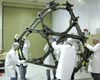 Magna UT (SPX) Feb 10, 2009
Scientists and engineers who have been working on the James Webb Space Telescope mission for years are getting very excited, because some of the actual pieces that will fly aboard the Webb telescope are now being built. One of the pieces, called the Backplane, is like a "spine" to the telescope. |
|
|

| The content herein, unless otherwise known to be public domain, are Copyright 1995-2007 - SpaceDaily.AFP and UPI Wire Stories are copyright Agence France-Presse and United Press International. ESA Portal Reports are copyright European Space Agency. All NASA sourced material is public domain. Additional copyrights may apply in whole or part to other bona fide parties. Advertising does not imply endorsement,agreement or approval of any opinions, statements or information provided by SpaceDaily on any Web page published or hosted by SpaceDaily. Privacy Statement |

 del.icio.us
 Digg
Digg Reddit
 YahooMyWeb
 Google
 Facebook