
 |
 |
 |
 |
 |
 |
 |
 |
 |

 |
China launches global positioning satellite: report
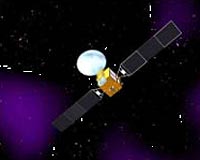
Beijing (AFP) April 15, 2009 China launched a navigational satellite Wednesday, the nation's space administration reported, the second in a series of up to 30 orbiters to comprise a global positioning network. The launch of the COMPASS satellite took place just after midnight from the Xichang Satellite Launching Centre in southwest Sichuan province, the China National Space Administration said on its website. The satellite is one of up to 30 that China will put in orbit by 2015 to form the Beidou Navigation System, a global positioning system (GPS) completely developed by Chinese technology, Xinhua news agency reported. "The system can help clients know their location at any time and place with accurate longitude, latitude and altitude data, and will offer 'safer' positioning, velocity, timing communications for authorised users," it said. The system will provide services for transportation, meteorology, petroleum prospecting, disaster forecasting, telecommunications and public security, it added. The system is expected to rival the US-developed GPS, the European Union's Galileo Positioning System and Russia's Global Navigation Satellite System (GLONASS). The first COMPASS satellite was launched in April 2007, Xinhua said, after four other experimental COMPASS satellites were placed in orbit earlier this century. Previous press reports said that China would launch 10 such navigational satellites in 2009 and 2010. Share This Article With Planet Earth
Related Links GPS Applications, Technology and Suppliers
 Symmetricom Awarded Contract On Next Gen GPS
 San Jose CA (SPX) Mar 31, 2009
Symmetricom has announced the company has been awarded a contract from ITT Corporation Space Systems Division valued at a minimum of $4 million, part of the building of GPS IIIA, the next generation Global Positioning System (GPS) Space System program. |
|
|

| The content herein, unless otherwise known to be public domain, are Copyright 1995-2007 - SpaceDaily.AFP and UPI Wire Stories are copyright Agence France-Presse and United Press International. ESA Portal Reports are copyright European Space Agency. All NASA sourced material is public domain. Additional copyrights may apply in whole or part to other bona fide parties. Advertising does not imply endorsement,agreement or approval of any opinions, statements or information provided by SpaceDaily on any Web page published or hosted by SpaceDaily. Privacy Statement |
 del.icio.us
 Digg
Digg Reddit
 YahooMyWeb
 Google
 Facebook