Energy News  
China's wild alligators to double in 10 years: report

China building new panda breeding centre: state media
China will start building a new giant panda breeding centre as early as next month after last year's 8.0-magnitude earthquake destroyed much of their habitat, state media reported Sunday. The new centre in the Wolong nature reserve will replace a destroyed base in southwestern Sichuan province where most of China's captive pandas were kept before the earthquake, the official Xinhua news agency reported. Huang Jianhua, the reserve's Communist party chief said a new location about 10 kilometres (six miles) from the old site was chosen "because the environment, water, weather and geological situations here are the best". "The pandas will be comfortable living here as it is not far from the former base," Huang was quoted as saying. "Safety is the priority." The new centre will cost 1.6 billion yuan (230 million dollars) with most of the funding coming from Hong Kong, Huang said, according to Xinhua. Five Wolong staff and one panda were killed in the May 12 earthquake, while two pandas were injured and one is still missing. Most of the reserve's pandas were moved after the quake to a nearby breeding centre in Ya'an City and zoos around the country. Six 18-month-old pandas stayed in prefabricated houses on the reserve, the report said. Wolong was built in 1980, as the world's largest breeding centre for the endangered species and was home to 142 captive pandas, about 60 percent of the world's total, the report said. There are about 1,590 pandas living in the wild around the country, mostly in Sichuan and the northern Shaanxi and northwestern Gansu provinces. A total of 180 are being bred in captivity, Xinhua reported.
by Staff Writers
Shanghai (AFP) April 19, 2009
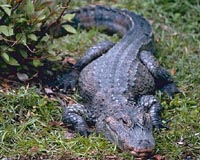
China's endangered Yangtze alligator population is expected to more than double to 300 in the wild within five to 10 years, state media reported Sunday.

Currently there are more than 120 alligators breeding in a wider area than five years ago, Wang Chaolin of the Chinese Alligators Protection Nature Reserve, in eastern Anhui Province, told Xinhua news agency.

"We have for the first time found wild baby alligators. Normally their survival rate is only two percent," Wang was quoted as saying. "The finding of the infants indicates the number of the species is increasing."

Wang said measures such as the protection of baby alligators and the releasing of captive-bred alligators into to the wild were helping bring the species back from the brink of extinction, the report said.

The Yangtze alligator, also known as the Chinese alligator, was once plentiful, particularly along China's eastern seaboard, Xinhua said.

But pollution, a warming climate and human activity have made it one of the world's most endangered creatures in the wild, it added.

"I'm confident the number will reach 300 in the future," Wang said. "But humans are still the biggest threat to the animal."

China has put the Chinese alligator at the top level of its list of protected species.

The Chinese Alligator Breeding Research Centre was set up in Anhui 30 years ago. Since then, the number of captive alligators at the centre has risen from about 200 to more than 10,000.

Share This Article With Planet Earth
del.icio.usdel.icio.us DiggDigg RedditReddit
YahooMyWebYahooMyWeb GoogleGoogle FacebookFacebook


Related Links
Darwin Today At TerraDaily.com


Memory Foam Mattress Review
Newsletters :: SpaceDaily :: SpaceWar :: TerraDaily :: Energy Daily
XML Feeds :: Space News :: Earth News :: War News :: Solar Energy News


How Life Shatters The Chemistry Mirror
Moffett Field CA (SPX) Apr 17, 2009
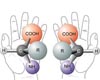
All of us are left-handed. At least, the bits that make up our proteins are. This is surprising since Nature is predominantly ambidextrous when it comes to assembling these molecules from scratch. Some scientists argue that left-handedness was handed down to us from space, but others say it just happened by chance in some little nook on the primordial Earth.


  • A Touch Of Potassium Yields Better Hydrogen-Storage Materials
  • UC Davis Receives Renewable Energy Programs Grant
  • China sends more patrols to South China Sea: report
  • Analysis: Niger Delta peace possible?

  • Poland, Estonia urge Lithuania to speed up atomic power project
  • Over 50 nations want to build nuclear plants: report
  • World's largest nuke plant to restart in quake-hit Japan town
  • Slovenia proposes former envoy Petric as new IAEA chief

  • Iridescent Ice Clouds From Aircraft Wings
  • Deep-Sea Rocks Point To Early Oxygen On Earth
  • Australia issues warning on Hong Kong's dirty air
  • Rendezvous With HALO

  • Damage To Forests Could Cost The Earth Its Major Carbon Sink
  • Forests could flip from sink to source of CO2: study
  • Environmentalists oppose Amazon road proposal
  • Potential To Amass More Carbon In Eastern North American Forests

  • Walker's World: G8's thin food summit
  • Changing Climate Will Lead To Devastating Loss Of Phosphorus From Soil
  • Brazil largest consumer of pesticides: study
  • China looks to farmers to boost economy

  • Britons offered cash grants to buy electric cars
  • GM aims to double China sales
  • Beijing extends post-Olympics car rules: report
  • Netherlands to introduce car trade-in bonus

  • China Eastern Airlines reports huge loss in 2008
  • Airlines fear failure of global climate talks
  • State takes control of China's first private airline: report
  • Troubled private Chinese airline says president missing

  • Nuclear Power In Space - Part 2
  • Nuclear Power In Space
  • Outside View: Nuclear future in space

  • The content herein, unless otherwise known to be public domain, are Copyright 1995-2007 - SpaceDaily.AFP and UPI Wire Stories are copyright Agence France-Presse and United Press International. ESA Portal Reports are copyright European Space Agency. All NASA sourced material is public domain. Additional copyrights may apply in whole or part to other bona fide parties. Advertising does not imply endorsement,agreement or approval of any opinions, statements or information provided by SpaceDaily on any Web page published or hosted by SpaceDaily. Privacy Statement