|
 |
 |
 |
 |
 |
 |
 |
 |

 |
Chinese Taikonauts May Build Communist Party Branch In Space
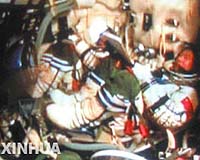
Beijing, China (XNA) Oct 19, 2007 Chinese taikonauts (astronauts) may start a branch of the Communist Party of China (CPC) in space, said the country's first taikonaut Yang Liwei. China now has a 14-strong astronaut team. The team members, including Yang himself, are all CPC members. "If China has its own space station, the taikonauts on mission will carry out the regular activities of a CPC branch in space in the way we do on earth, such as learning the Party's policies and exchanging opinions on the Party's decisions," said Yang, a delegate to the on-going CPC national congress in Beijing. "If we establish a Party branch in space, it would also be the 'highest' of its kind in the world," said Yang, who is also deputy director of the China Astronaut Research and Training Center. According to the CPC Constitution, a grass-root CPC organization should be established where there are three or more CPC members. The latest official figure shows that China has more than 73 million CPC members and about 3.6 million grass-roots CPC organizations. "Like foreign astronauts having their beliefs, we believe in Communism, which is also a spiritual power," said Yang. "We may not pray in the way our foreign counterparts do, but the common belief has made us more united in space, where there is no national boundary, to accomplish our missions." China successfully sent Yang into orbit on the Shenzhou V spacecraft in 2003, and two years later, taikonauts Fei Junlong and Nie Haisheng completed a five-day flight on the Shenzhou VI. Earlier media reports say the Shenzhou VII is expected to carry three taikonauts in 2008 and the taikonauts may perform their first spacewalk during the flight. "We will see more international cooperation in space in the future and the different beliefs of taikonauts will not be a 'trouble' for the cooperation," said Yang. "Cooperation is the inevitable trend of the development of the world's space industry and Chinese taikonauts will also participate in international operations like peace-keeping, environment protection and rescue in space, which require our taikonauts to increase their sense of cooperation and responsibilities as members of a global village," he said. Yang's center has been working with the Aerospace School of the Beijing-based Tsinghua University since 2006 to provide masters-level degree training for the taikonauts. "New courses include the law of space, the history of aviation and others on the cultures of different countries," said Yang. In addition, the taikonauts have been learning English and Russian. "Now, it's no problem for us to communicate with foreign colleagues in English and Russian," he said.
Source: Xinhua News Agency Community Email This Article Comment On This Article Related Links Space Tourism, Space Transport and Space Exploration News
 Russia To Develop New Carrier Rocket For Kliper
 Moscow, Russia (RIA Novosti) Oct 18, 2007
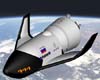
Russia's space agency will soon announce a tender to develop a new carrier rocket, to ensure successful implementation of its manned-flight program, a top space official said Wednesday. "A special commission will determine the design criteria [for the new space vehicle] and the domestic companies eligible for participation in the tender," said Anatoly Perminov, the head of the Federal Space Agency. The Federal Space Program for 2006-2015 stipulates the construction of a reusable "Clipper" spacecraft jointly with European partners, and two carrier rockets, the Angara and the Soyuz-2. |
|
|
| The content herein, unless otherwise known to be public domain, are Copyright Space.TV Corporation. AFP and UPI Wire Stories are copyright Agence France-Presse and United Press International. ESA Portal Reports are copyright European Space Agency. All NASA sourced material is public domain. Additional copyrights may apply in whole or part to other bona fide parties. Advertising does not imply endorsement, agreement or approval of any opinions, statements or information provided by Space.TV Corp on any Web page published or hosted by Space.TV Corp. Privacy Statement |