|
 |
 |
 |
 |
 |
 |
 |
 |

 |
Climate Change Sucks Water From China's Two Longest Rivers
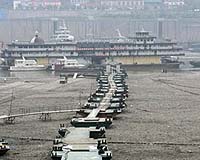
Beijing (Xinhua) Jul 27, 2007 Climate change linked to the contraction of wetlands at the source of China's two longest rivers, the Yangtze and the Yellow River, has reduced the volume of water flowing in the rivers, said Chinese scientists. Scientists from the Institute of Mountain Hazards and Environment under the Chinese Academy of Sciences (CAS) studied changes over the past 40 years to the wetlands on the cold Qinghai-Tibet Plateau in west China where the two rivers have their source. Analyzing aerial photos and satellite remote sensing figures, they found that the wetlands on the plateau have shrunk more than 10 percent over the past four decades. The wetlands at the origin of the Yangtze River suffered the most, contracting by 29 percent. In addition, about 17.5 percent of the small lakes at the source of the Yangtze River have dried up, said the scientists. "The wetland plays a key role in containing water and adjusting the water volume of the rivers," said Wang Xugen, a researcher with the Institute of Mountain Hazards and Environment. "The shrinking of the wetland on the plateau is closely connected with global warming," Wang said, adding that -- even though rainfall has increased in the region -- the contraction of the wetland has reduced the flow of the Yangtze and Yellow rivers. Figures provided by the World Wildlife Fund (WWF) weather station at the head of the Yangtze River showed that annual rainfall at the source of the Yangtze River increased from 260 mm during 1991-2000 to 323 mm in the period 2001-2006. "But the increased rainfall didn't lead to more water flow in the rivers because the evaporation was so fast as a result of global warming," said Li Shijie, a researcher with the Nanjing Institute of Geography and Limnology under the CAS. Another WWF study showed that global warming has caused glaciers to shrink, frozen earth to melt, grasslands to turn yellow and rivers to dry up in Tibet. The Qinghai-Tibet Plateau used to boast 36,000 glaciers covering an area of 50,000 sq km which feed several of the major rivers in China and Southeast Asia. In the past 100 years, the area of these glaciers has shrunk by 30 percent. The scientists called for more support for ecological research on the Qinghai-Tibet Plateau and better protection of the unique and vulnerable environment.
Source: Xinhua News Agency Community Email This Article Comment On This Article Related Links The shrinking Yangtze river. Photo courtesy AFP. Climate Science News - Modeling, Mitigation Adaptation
 Climate Change, Energy Security Top APEC Agenda
 Singapore (AFP) July 25, 2007
Asia Pacific economies are expected to discuss a common response to climate change and energy security at the annual summit of their leaders in Australia next month, an official said Wednesday. Colin Heseltine, executive director of the Asia Pacific Economic Cooperation (APEC) forum secretariat, said Australian Prime Minister John Howard has written to other leaders indicating his desire for a discussion on the issues. "A major issue that has rapidly emerged at the top of APEC leaders' priorities this year is to develop a coherent regional policy response to... big challenges now facing APEC member economies: energy security and climate change," Heseltine said. |
|
|
| The content herein, unless otherwise known to be public domain, are Copyright Space.TV Corporation. AFP and UPI Wire Stories are copyright Agence France-Presse and United Press International. ESA Portal Reports are copyright European Space Agency. All NASA sourced material is public domain. Additional copyrights may apply in whole or part to other bona fide parties. Advertising does not imply endorsement, agreement or approval of any opinions, statements or information provided by Space.TV Corp on any Web page published or hosted by Space.TV Corp. Privacy Statement |