|
 |
 |
 |
 |
 |
 |
 |
 |

 |
Climate's Remote Control On Hurricanes
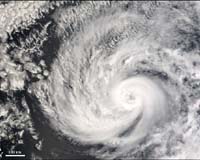
Virginia Key FL (SPX) Dec 13, 2007 Natural climate variations, which tend to involve localized changes in sea surface temperature, may have a larger effect on hurricane activity than the more uniform patterns of global warming, a report in this week's Nature suggests. In the debate over the effect of global warming on hurricanes, it is generally assumed that warmer oceans provide a more favorable environment for hurricane development and intensification. However, several other factors, such as atmospheric temperature and moisture, also come into play. Drs. Gabriel A. Vecchi of the NOAA Geophysical Fluid Dynamics Laboratory and Brian J. Soden from the University of Miami Rosenstiel School of Marine and Atmospheric Science analyzed climate model projections and observational reconstructions to explore the relationship between changes in sea surface temperature and tropical cyclone 'potential intensity' - a measure that provides an upper limit on cyclone intensity. They found that warmer oceans do not alone produce a more favorable environment for storms because the effect of remote warming can counter, and sometimes overwhelm, the effect of local surface warming. "Warming near the storm acts to increase the potential intensity of hurricanes, whereas warming away from the storms acts to decrease their potential intensity," Vecchi said. Titled "Effect of Remote Sea Surface Temperature Change on Tropical Cyclone Potential Intensity," their study found that long-term changes in potential intensity are more closely related to the regional pattern of warming than to local ocean temperature change. Regions that warm more than the tropical average are characterized by increased potential intensity, and vice versa. "A surprising result is that the current potential intensity for Atlantic hurricanes is about average, despite the record high temperatures of the Atlantic Ocean over the past decade." Soden said. "This is due to the compensating warmth in other ocean basins." "As we try to understand the future changes in hurricane intensity, we must look beyond changes in Atlantic Ocean temperature. If the Atlantic warms more slowly than the rest of the tropical oceans, we would expect a decrease in the upper limit on hurricane intensity," Vecchi added. "This is an interesting piece of the puzzle." "While these results challenge some current notions regarding the link between climate change and hurricane activity, they do not contradict the widespread scientific consensus on the reality of global warming," Soden noted. Community Email This Article Comment On This Article Related Links University of Miami Rosenstiel School of Marine and Atmospheric Science Bringing Order To A World Of Disasters When the Earth Quakes A world of storm and tempest
 Cyclone batters Fiji island: officials
 Suva (AFP) Dec 8, 2007
A devastating cyclone flattened much of the tiny Fiji island of Cikobia on Saturday with most houses and vegetation destroyed, but its 69 villagers survived by hiding in caves, officials said. |
|
|
| The content herein, unless otherwise known to be public domain, are Copyright Space.TV Corporation. AFP and UPI Wire Stories are copyright Agence France-Presse and United Press International. ESA Portal Reports are copyright European Space Agency. All NASA sourced material is public domain. Additional copyrights may apply in whole or part to other bona fide parties. Advertising does not imply endorsement, agreement or approval of any opinions, statements or information provided by Space.TV Corp on any Web page published or hosted by Space.TV Corp. Privacy Statement |