
 |
 |
 |
 |
 |
 |
 |
 |
 |

 |

London, UK (SPX) May 05, 2011 Rock climbers are having a negative impact on rare cliff-dwelling plants, ecologists have found. Writing in the British Ecological Society's Journal of Applied Ecology they say that in areas popular with climbers, conservation management plans should be drawn up so that some cliffs are protected from climbers. The Northern Franconian Jura and the Swabian Alb are two of Germany's most important climbing areas but also the last European stronghold of the rare yellow whitlowgrass (Draba azoides) - a small plant that lives on limestone cliffs where it forms cushion-like rosettes. To find out how climbing in the area was affecting the plant, Frank Vogler and Christoph Reisch of the University of Regensburg compared the number and distribution of D. azoides on eight cliffs that had been climbed for at least the past 50 years with eight pristine, unclimbed cliffs of similar size and aspect. They also tested the plants' DNA to find out how climbers affected its genetic variation. They found that on climbed cliffs, the plants were smaller and fewer in number on cliff faces but more frequent on the scree - the broken rock fragments at the base of the cliffs. According to Dr Reisch: "Climbing adversely affects these plants in a direct way. Abrasion by climbing ropes and using cracks and ledges as hand and footholds obviously lead to a decline in the species' abundance." Genetic fingerprinting showed that compared with climbed cliffs, there were greater genetic differences between plants living at different heights on the pristine cliffs, meaning that by displacing plants the climbers are also moving their genes down the cliff. These genetic changes could, in the long-term, affect the plants' fitness to survive in an environment it has spent thousands of years adapting to. "Seed dispersal is presumably enhanced by rock climbers. But climbers also remove and drop individual plants from cliff faces, causing a downward shift in population structure. This shift reduces the genetic differences between the plant populations living at different heights on the cliff," says Dr Reisch. Because of their inaccessibility, cliffs are among the few ecosystems to be relatively unaffected by humans over the last centuries. Cliffs harbour a multitude of rare and endangered plant species and make a major contribution to regional biodiversity, so more effort needs to be made to conserve them. "In mountain regions popular with climbers, conservation management plans should always ensure that some cliffs are out-of-bounds to climbers so that the native vegetation is protected," he concludes. Frank Vogler and Christoph Reisch (2011), 'Genetic variation on the rocks - the impact of climbing on the population ecology of a typical cliff plant', doi: 10.1111/j.1365-2664.2011.01992.x, is published in the Journal of Applied Ecology on 4 May 2011.
Share This Article With Planet Earth
Related Links Darwin Today At TerraDaily.com

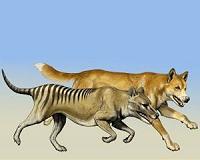 Thylacine hunting behavior A Case of crying wolf
Providence RI (SPX) May 05, 2011 Its head and body looked like a dog, yet its striped coat was cat-like. It carried its young in a pouch, like a kangaroo. No wonder the thylacine - the enigmatic, iconic creature of Australia and Tasmania - was the object of so much confusion, alternately called the "marsupial wolf" and the "Tasmanian tiger." So what was it? By studying bones of thylacines and 31 other mammals, researchers ... read more |
|
|
| The content herein, unless otherwise known to be public domain, are Copyright 1995-2010 - SpaceDaily. AFP and UPI Wire Stories are copyright Agence France-Presse and United Press International. ESA Portal Reports are copyright European Space Agency. All NASA sourced material is public domain. Additional copyrights may apply in whole or part to other bona fide parties. Advertising does not imply endorsement,agreement or approval of any opinions, statements or information provided by SpaceDaily on any Web page published or hosted by SpaceDaily. Privacy Statement |


 del.icio.us
 Digg
Digg Reddit
 YahooMyWeb
 Google
 Facebook


