
 |
 |
 |
 |
 |
 |
 |
 |
 |

 |
Climbing Into Space By The Rope
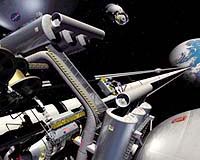
Moscow (RIA) Feb 19, 2009 There is no limit to human imagination when it comes to reaching heights. Sometimes, a miraculous elixir makes it possible to fly in the skies with a crazy speed, or there appear space ships, counterparts of aircraft with unlimited potentialities. We also know about more primitive fancies, when something grows on Earth to such a height that space seems to be near. It is this latter primitive version that is most likely to be translated into reality. It amounts to a space elevator. The program for its development has been recently carried out much faster owing to progress in the production of super-durable light materials. Let's imagine a simple picture. Someone has tied up a stone to the end of a rope and is twisting it around. The stone rotates, and the rope is stretched out under the impact of the centrifugal force. Let's imagine one end of the rope is fixed at the equator, and the other is tied up to a satellite. The centrifugal force won't allow the rope to fall on Earth. The gravity decreases in proportion to the square of distance, while the centrifugal force grows with an increase in the distance. Calculations show that at the height of about 42,000 km this force will be equal to gravity. If we make a wire rope of that length, we will get a direct roadway from Earth to space. This is not at all a fantastic idea. It is based on simple physical laws. Serious researchers could not get a peace of mind because of its simplicity for a long time. Konstantin Tsiolkovsky talked about an elevator into space in 1895. In 1960, Soviet engineer Yury Artsyutanov published an article in which he set forth in detail the concept of such a space elevator and noted an enormous economic effect that it could produce. However, at that time no equipment could produce the materials of the required durability and mass. This time NASA specialists rather than Russian scientists have come back to this idea. In August 2000 they published a project whereby several super-durable 35,000 km-long wire ropes are fixed to the upper end of a giant 50 km-high ground-based tower. In space, the wire ropes are tied up to a special satellite. Platforms on electromagnetic engines will move by the wires to carry astronauts and loads. Making wire ropes was the only problem, but it seems British experts have resolved it. Nanotechnologists from Cambridge have developed a flexible and very durable light carbonic thread. For the time being, they can only make one gram of this material per day, which is enough to spread the thread for 29 km. A space elevator will require 232,000 km of the thread. It will take more than a decade before it is launched. In NASA's estimate, the project will cost more than $10 billion, but the game is still worth the candle. Experts believe that it will cost no more than $1.5 to get one kilo of a load to space because of the space elevator's low operational expense. Obviously, the construction of a space elevator will become the most grandiose project in human history. A tremendous amount of scientific, technical, material and political problems will make it possible only on condition of close international cooperation. The opinions expressed in this article are the author's and do not necessarily represent those of RIA Novosti.
Source: RIA Novosti Share This Article With Planet Earth
Related Links - Space Tourism, Space Transport and Space Exploration News
 MDA Plays Significant Role In Planning Future Global Space Explorations
 Richmond, Canada (SPX) Feb 19, 2009
MacDonald, Dettwiler and Associates has announced it has been selected to deliver concept design solutions to support planning of Canada's potential participation in global space exploration. The Canadian Space Agency contracts are worth $1.8 million (CAD). |
|
|

| The content herein, unless otherwise known to be public domain, are Copyright 1995-2007 - SpaceDaily.AFP and UPI Wire Stories are copyright Agence France-Presse and United Press International. ESA Portal Reports are copyright European Space Agency. All NASA sourced material is public domain. Additional copyrights may apply in whole or part to other bona fide parties. Advertising does not imply endorsement,agreement or approval of any opinions, statements or information provided by SpaceDaily on any Web page published or hosted by SpaceDaily. Privacy Statement |
 del.icio.us
 Digg
Digg Reddit
 YahooMyWeb
 Google
 Facebook