
 |
 |
 |
 |
 |
 |
 |
 |
 |

 |
Cluster's Insight Into Space Turbulence
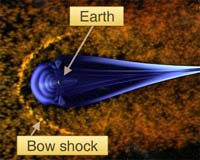
Paris, France (ESA) Mar 27, 2009 The four satellites of ESA's Cluster mission have revealed, for the first time, how turbulence develops in space just outside the Earth's magnetic environment. This result improves the understanding of turbulence, a key physical process by which energy throughout the Universe is transported from large scales at which it is input, to all scales where it is dissipated. Turbulence is a phenomenon familiar to every air traveler, but how many know that turbulence also exists in space? Just as the turbulence experienced by aircraft is caused by high-speed winds, turbulence in space can be caused by the solar wind, an uninterrupted flow of high-speed solar particles. Thanks to the Earth's magnetic field, most of this solar material is deflected around the Earth's magnetosphere (blue region in Figure 1), delimited by the magnetopause. The solar wind, when it reaches a magnetized planet, is first decelerated from supersonic to subsonic speed by a shock wave (called the bow shock), located in front of the magnetopause. The region between the bow shock and the magnetopause is called the magnetosheath. This region is one of the most turbulent environments of near-Earth space, making it an excellent laboratory in which to study turbulence. Other environments such as the solar atmosphere, or accretion disks around young stars, are likely to exhibit similar behaviour, but the terrestrial magnetosheath is by far the most accessible place to perform in situ measurements. Characterising the properties of the magnetic turbulence in this region is of prime importance to understand its role in fundamental processes such as energy dissipation or the acceleration of particles to high-energies. In March 2007, a Nature Physics publication reported for the first time that not only did turbulence exist in the magnetosheath in the form of many all magnetic islands (with a typical size of 100 km), but also that magnetic reconnection occurred within these islands. The observations showed that the turbulent plaa is accelerated and heated during the reconnection process. The discovery of reconnection in turbulent plaa has significant implications for the study of laboratory and astrophysical plaas, where both turbulence and reconnection naturally develop and thus where turbulent reconnection is very likely to occur. Possible applications range from the dissipation of the magnetic energy in fusion devices on Earth, such as the ITER project (Figure 2), to the acceleration of high-energy particles in solar flares (Animation 1). This discovery was based on data collected by the four Cluster spacecraft when they were flying together in formation with a very short separation distance (~ 100 km). A more recent study, published on 23 May 2008 in Physical Review Letters, again made use of data collected by the four Cluster satellites but this time with an inter-spacecraft separation of several thousands of kilometers. This configuration enabled the study of magnetosheath turbulence at large scales. Magnetic field data collected on 16 April 2003 by the four satellites (C1, C2, C3 and C4) are plotted in Figure 3a (offset by 20 nT for clarity) while Figure 3b displays the spacecraft positions with respect to the Earth's bow shock (thick dashed blue vertical line). At this time the Cluster satellites were widely spread in space, from just behind the bow shock (C3 and C4) to more than 8,000 kilometers away (C1), while C2 was located in between. The paper details a complex data analysis of the 4 minute interval marked in yellow in Figure 3a. One property of the turbulence, the intermittency, was studied in particular and was accurately reproduced with a theoretical model. The intermittency appears in the transfer (or the cascade) of the energy from large scales to all scales as an uneven distribution of the energy between the scales and this was used to examine the evolution of the turbulence in the magnetosheath "For the first time we use multi-spacecraft observations to characterize the evolution of magnetosheath turbulence. The intermittency significantly changes over the distance, being increasingly stronger away from the bow shock", says Dr. Emiliya Yordanova, lead author of this study. "Magnetic reconnection, turbulence and shocks are three fundamental ingredients of the plaa Universe. The detailed understanding of these key processes and their associated multi-scale physics is a challenge for the future of space physics. One of the lessons learned from the Cluster mission is the need for new space missions equipped with instruments of higher sensitivity and better time resolution along with a larger number of satellites to sample different scale sizes simultaneously. Such a mission concept exists: a fleet of 12 satellites named Cross-Scale. This is a candidate mission within the ESA Coic Vision programme", says Matt Taylor, acting ESA Cluster project scientist. Share This Article With Planet Earth
Related Links Cluster Understanding Time and Space
 One Step Closer To Finding The Higgs Boson
 Bloomington IN (SPX) Mar 17, 2009
Six Indiana University physicists collaborating with researchers from around the world have helped move mankind one step closer to finding the Higgs boson, the still unidentified particle predicted by the Standard Model to be the origin of mass for all elementary particles. |
|
|

| The content herein, unless otherwise known to be public domain, are Copyright 1995-2007 - SpaceDaily.AFP and UPI Wire Stories are copyright Agence France-Presse and United Press International. ESA Portal Reports are copyright European Space Agency. All NASA sourced material is public domain. Additional copyrights may apply in whole or part to other bona fide parties. Advertising does not imply endorsement,agreement or approval of any opinions, statements or information provided by SpaceDaily on any Web page published or hosted by SpaceDaily. Privacy Statement |
 del.icio.us
 Digg
Digg Reddit
 YahooMyWeb
 Google
 Facebook