
 |
 |
 |
 |
 |
 |
 |
 |
 |

 |
Countering Piracy By Maintaining The Status Quo
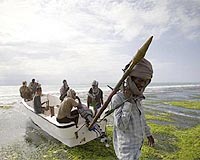
Moscow (RIA Novosti) Jan 22, 2009 The U.S. Navy is finally joining international forces in the fight against the Somali piracy. The U.S. Fifth Fleet is going to deploy its forces specifically for this purpose, teaming up with the Combined Task Force 151. Supposedly, it will be composed of U.S. allies' ships and units, hence its name, the Combined Task Force. Thus, the world's most powerful fleet will embark on ensuring navigation security off the Somali coast, where the ships of the European Union's Naval Task Force, as well as the Russian, Indian and Chinese navies, have been carrying out this mission. Navigation security is ensured by caravans of two to five ships, which convoy civil vessels through the dangerous area and patrol the coast to detect and search waterborne vehicles suspected of being piratical. The patrolling is performed also by shipborne helicopters and patrol jets, which aim battleships at detected targets. Apart from crews, there are also marine units which land on escorted ships periodically to protect them in case of a pirate attack. Marines also examine vessels detained under suspicion of piracy. Unfortunately, excesses occur sometimes: For example, on November 19 the Indian frigate Tabar sank a Thai trawler which it mistook for a pirate vessel. One cannot say yet that the counter-piracy efforts have had any effect; at any rate, pirates have not hijacked any new ships recently. At the same time, they have released several ships seized earlier, including the Iranian vessel Delight, which was hijacked on November 20, and the Turkish ship M/V Yasa Neslihan, captured in late December. The Saudi supertanker Sirius Star, ransomed recently, has also been released, according to pirates. However, other data suggest that it is still near the Somali coast: Pirates cannot leave the ship because of the rough sea. The five pirates who tried to reach the coast by boat died after the boat turned over hit by a huge wave. Local residents found one of the bodies on the shore, with $153,000 in his pockets. The Ukrainian dry-cargo ship Faina remains in captivity; negotiations for ransoming its crew and cargo have been unsuccessful so far. Unfortunately, given the present economic situation in Ukraine, one can hardly expect the vessel to be ransomed soon, or any other method to be used to release the hostages. In any case, through high costs, the world's leading military powers will most likely manage to keep the trouble at bay - it will simply become too dangerous to attack the ships going past the Somali coast, and pirates will become less active. Only best-prepared and well organized groups capable of hijacking a ship several hundred miles off the coast, taking its crew hostage and bringing the booty to a port will continue operating, as was in the case of the Sirius Star tanker. International forces cannot guarantee that such a capture is impossible. Experts have repeatedly pointed out that in order to eradicate the Somali piracy it is necessary to normalize the situation in Somalia, including a ground operation to destroy pirates' bases; but it is an absolutely different task, with absolutely different forces required for its implementation. The opinions expressed in this article are the author's and do not necessarily represent those of RIA Novosti.
Source: RIA Novosti Share This Article With Planet Earth
Related Links - 21st Century Pirates
 Cabinet backs plan to send SKorea warship against Somali pirates
 Seoul (AFP) Jan 20, 2009
Seoul's cabinet on Tuesday approved a plan to send a warship and 310 troops to combat piracy off Somalia where several South Korean ships have been seized, officials said. |
|
|

| The content herein, unless otherwise known to be public domain, are Copyright 1995-2007 - SpaceDaily.AFP and UPI Wire Stories are copyright Agence France-Presse and United Press International. ESA Portal Reports are copyright European Space Agency. All NASA sourced material is public domain. Additional copyrights may apply in whole or part to other bona fide parties. Advertising does not imply endorsement,agreement or approval of any opinions, statements or information provided by SpaceDaily on any Web page published or hosted by SpaceDaily. Privacy Statement |
 del.icio.us
 Digg
Digg Reddit
 YahooMyWeb
 Google
 Facebook