
 |
 |
 |
 |
 |
 |
 |
 |
 |

 |
Creating Diamonds In Space
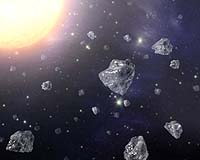
Hertfordshire, UK (SPX) Apr 27, 2009 Do you know that there are countless diamonds in space? Loads of tiny diamonds, each measuring one micrometer (less than the width of a human hair) are located in the material that surrounds some stars--their circumstellar disks. Although circumstellar diamonds account for little of a disk's weight, their combined volume would be as large as part of a moon. Nevertheless, few stars have been identified which show clear evidence of diamonds in their disks. Why are only a small number of stars adorned by diamonds? How can we find more of them? Astronomers have been using the Subaru Telescope to seek the answers to these questions. They have learned that creating diamonds in space requires very special conditions.
A Celestial Detective Story The first such signature was discovered in 1983 in the circumstellar disk of Elias 1, a young star located in the direction of Taurus (Whittet et al. 1983, A and A, 12, 01). Elias 1 is one of many Herbig Ae/Be (HAEBE) stars - young, very bright stars of intermediate mass, about 1.5-10 times as massive as the sun. Although extensive surveys of sixty other HAEBE stars have been conducted since then, scientists have found only three stars with such distinctive emission lines in their disks (e.g. Acke et al. 2006, A and A, 422, 612). After more than fifteen years of puzzling over the reasons for these signature lines, astronomers have concluded that diamonds are the carriers of these emissions. (Guillois et al. 1999, ApJL, 521, L133). The question remains: Why are there so few diamond-studded stars?
Clues for Finding Stars with Diamonds The scientists then related this finding to another intriguing feature of two of the three stars with diamonds: Large X-ray flares are observed near them. For stars of intermediate mass, like Elias 1, it is rather uncommon to have a strong X-ray emission, let alone an X-ray flare. Were these rare occurrences - diamonds and X-ray flares - linked together in some way? Clues to an answer came from comparing how diamonds are formed on earth with how they might be created in space. Making a natural diamond on earth requires extremely high pressure and temperature, conditions that usually occur deep underground on earth. The most difficult hurdle to overcome in developing diamonds in space is its low pressure. How can we find such high pressure in the vacuum of interstellar space? Findings from previous laboratory experiments provided the astronomers with a possible answer. In 1996, physicists in Germany found that tiny diamond particles formed at the core of "carbon onions" when they fired high-energy electron beams into a vacuum (Banhart and Ajayan 1996, Nature, 382, 433). The key to diamond formation is that the carbon onion, made up of a shell of multiple layers of carbons, works as a natural pressure container. The high-energy electrons shot into the onion knock out the carbon atoms in the shell. With fewer atoms now supporting the surface, the shell physically shrinks. As the firing of electrons continues, the shell continues to shrink. Finally, ultrahigh pressure, thousands of times more intense than earth's atmosphere, builds up in the center of the onion. Another laboratory experiment demonstrated that warm temperature is necessary to foster the growth of diamond particles on the surface of the carbon onion (Zaiser and Banhart 1997, Phys. Rev. Lett. 79, 3680). Led by the MPIA, the scientific team drew parallels between the laboratory findings and what happens in interstellar space. The X-ray flares seem to come from the lighter companions to the primary stars of the binary systems, where two stars are consistently associated with each other. Particle acceleration always accompanies the X-ray flare, as these two come from the same energetic phenomena related to stellar magnetic activity. These conditions could result in a carbon onion in space, with the necessary high pressure to create diamonds.
The Circumstellar Disk Is the Treasure Chest Also, diamond stars must have special ingredients: a disk, a hot central star and a companion emitting hard X-rays. The star must be of intermediate mass that can warm up the disk to a medium temperature. Then, carbon onions can form, providing the cradle for diamond creation. The need for such special conditions would explain why we see so few stars with diamond signatures in their disks. The findings of this research will raise even more questions and speculation about the formation of these fascinating crystals. It's possible that there are tons of diamonds that we cannot yet see because their emission features are shielded by onion shells. Thanks to the data collected from observations with the Subaru Telescope as well as the international team's intriguing interpretation of their findings, we now have more definite steps for discovering the circumstellar treasure chests with diamonds in space. Share This Article With Planet Earth
Related Links NAOJ Stellar Chemistry, The Universe And All Within It
 Dust Cleared To Get Better Look At Youngest Supernova Remnant
 Raleigh NC (SPX) Apr 24, 2009
Researchers at North Carolina State University have used a mathematical model that allows them to get a clearer picture of the galaxy's youngest supernova remnant by correcting for the distortions caused by cosmic dust. |
|
|

| The content herein, unless otherwise known to be public domain, are Copyright 1995-2007 - SpaceDaily.AFP and UPI Wire Stories are copyright Agence France-Presse and United Press International. ESA Portal Reports are copyright European Space Agency. All NASA sourced material is public domain. Additional copyrights may apply in whole or part to other bona fide parties. Advertising does not imply endorsement,agreement or approval of any opinions, statements or information provided by SpaceDaily on any Web page published or hosted by SpaceDaily. Privacy Statement |
 del.icio.us
 Digg
Digg Reddit
 YahooMyWeb
 Google
 Facebook