|
 |
 |
 |
 |
 |
 |
 |
 |

 |
Cyprian Honeybees Kill Their Enemy By Smothering Them
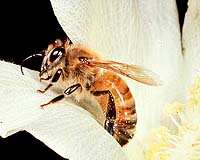
Thessaloniki, Greece (SPX) Sep 19, 2007 For the first time, researchers have discovered that when Cyprian honeybees mob and kill their arch enemy, the Oriental hornet, the cause of death is asphyxiation. They reported their findings in the September 18, 2007, issue of Current Biology, a publication of Cell Press. "Here, for the first time we detail an amazing defense strategy, namely asphyxia-balling, by which Cyprian honeybees mob the hornet and smother it to death," said Gerard Arnold of CNRS in Gif-sur-Yvette, France. "The domestic bee has never ceased surprising us." Previous studies showed that Asian honeybees similarly attack hornets, leading the predatory insects to die from the heat inside the ball of bees. That murderous "thermo-balling" strategy is used against invaders, mainly hornets, armored with a hard cuticle that is impenetrable to the bees' most familiar weapon: their stingers. However, scientists knew from earlier studies that various subspecies of the domestic honeybee (Apis mellifera), which form comparable balls around hornets, couldn't raise the temperature high enough to finish off the heat-tolerant hornets, explained the study's first author, Alexandros Papachristoforou of Aristotle University of Thessaloniki, Greece. It had been shown that the mobbing bees go for the gut, targeting the hornets' abdomen, which is critical for the insects' ability to breathe. By pumping their abdominal muscles, the hornets bring in air through small openings called spiracles, which are covered by structures known as tergites when air is released. To find out whether the bees could be blocking the hornets' breathing, the researchers monitored their respiration under normal conditions and those designed to mimic the balling behavior, in which they covered either two or four of the insects' tergites. The hornets' respiration declined by about 33 and 87 percent, respectively, in these experiments. Next, they tested whether the bees could kill hornets whose tergites were held open with tiny plastic blocks. They found that the bees took twice as long to kill such manipulated hornets. "To kill the high-temperature-tolerant hornet, Cyprian honeybees have developed an alternate strategy to thermo-balling and stinging," Arnold said. "They appear to have identified the hornets' 'Achilles heel' by asphyxiating the predator. This ability indicates that under extreme conditions, honeybees can present a high level of adaptation in order to survive." The researchers include Alexandros Papachristoforou, Andreas Thrasyvoulou, Georgia Zafeiridou, and George Theophilidis of Aristotle University of Thessaloniki; Agn�s Rortais, Lionel Garnery, and Gerard Arnold of Laboratoire Evolution, Genomes, Speciation, CNRS UPR9034. This work was partly supported by the bilateral program ZENON, the Research Promotion Foundation of Cyprus and the Greek program HERAKLEITOS (EPEAEK). Community Email This Article Comment On This Article Related Links The Flowers and Fruits of Earth
 Boeing Builds First GPS IIF Satellite
 St. Louis MO (SPX) Sep 13, 2007
Boeing has successfully assembled and integrated all flight hardware onto the first Global Positioning System (GPS) IIF satellite. GPS llF will bring new capabilities to the GPS constellation such as full onboard encrypted military code, a new civil signal, crosslink enhancements, signal power increases and longer design life. |
|
|
| The content herein, unless otherwise known to be public domain, are Copyright Space.TV Corporation. AFP and UPI Wire Stories are copyright Agence France-Presse and United Press International. ESA Portal Reports are copyright European Space Agency. All NASA sourced material is public domain. Additional copyrights may apply in whole or part to other bona fide parties. Advertising does not imply endorsement, agreement or approval of any opinions, statements or information provided by Space.TV Corp on any Web page published or hosted by Space.TV Corp. Privacy Statement |