
 |
 |
 |
 |
 |
 |
 |
 |
 |

 |
Decisive Action Needed As Warming Predictions Worsen
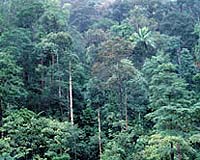
Stanford CA (SPX) Feb 20, 2009 Greenhouse gases in the atmosphere are rising more rapidly than expected, increasing the danger that without aggressive action to reduce emissions the climate system could cross a critical threshold by the end of the century, warns a leading member of the Nobel Prize-winning Intergovernmental Panel on Climate Change. Studies indicate that greenhouse warming could trigger a vicious cycle of feedback, in which carbon dioxide released from thawing tundra and increasingly fire-prone forests drives global temperatures even higher. Chris Field, director of the Carnegie Institution's Department of Global Ecology and co-chair of the IPCC Working Group 2, will address these issues at a symposium titled "What Is New and Surprising since the IPCC Fourth Assessment?" at the annual meeting of the American Association for the Advancement of Science (AAAS) in Chicago. The IPCC Fourth Assessment, for which Field was a coordinating author, was published in 2007. As co-chair, Field will oversee the Working Group 2 Report on the predicted impacts of climate change for the IPCC Fifth assessment, scheduled to be published in 2014. The Fifth Assessment will incorporate the results of new studies that predict more severe changes than did previous assessments. "The data now show that greenhouse gas emissions are accelerating much faster than we thought," says Field. "Over the last decade developing countries such as China and India have increased their electric power generation by burning more coal. Economies in the developing world are becoming more, not less carbon-intensive. We are definitely in unexplored terrain with the trajectory of climate change, in the region with forcing, and very likely impacts, much worse than predicted in the fourth assessment." New studies are also revealing potentially dangerous feedbacks in the climate system that could convert current carbon sinks into carbon sources. Field points to tropical forests as a prime example. Vast amounts of carbon are stored in the vegetation of moist tropical forests, which are resistant to wildfires because of their wetness. But warming temperatures and shifting rainfall patterns threaten to dry the forests, making them less fireproof. Researchers estimate that loss of forests through wildfires and other causes during the next century could boost atmospheric concentration of CO2 by up to 100 parts per million over the current 386 ppm, with possibly devastating consequences for global climate. Warming in the Arctic is expected to speed up the decay of plant matter that has been in cold storage in permafrost for thousands of years. "There is about 1,000 billion tons of carbon in these soils," says Field. "When you consider that the total amount of carbon released from fossil fuels since the beginning of the Industrial Revolution is around 350 billion tons, the implications for global climate are staggering." "The IPCC fourth assessment didn't consider either the tundra-thawing or tropical forest feedbacks in detail because they weren't yet well understood," he says. "But new studies are now available, so we should be able to assess a wider range of factors and possible climate outcomes. One thing that seems to be certain, however, is that as a society we are facing a climate crisis that is larger and harder to deal with than any of us thought. The sooner we take decisive action, the better our chances are of leaving a sustainable world to future generations." Share This Article With Planet Earth
Related Links Carnegie Institution Climate Science News - Modeling, Mitigation Adaptation
 Scientists map CO2 emissions with Google Earth
 Washington (AFP) Feb 19, 2009
A team of US scientists led by Purdue University unveiled an interactive Google Earth map on Thursday showing carbon dioxide emissions from fossil fuels across the United States. |
|
|

| The content herein, unless otherwise known to be public domain, are Copyright 1995-2007 - SpaceDaily.AFP and UPI Wire Stories are copyright Agence France-Presse and United Press International. ESA Portal Reports are copyright European Space Agency. All NASA sourced material is public domain. Additional copyrights may apply in whole or part to other bona fide parties. Advertising does not imply endorsement,agreement or approval of any opinions, statements or information provided by SpaceDaily on any Web page published or hosted by SpaceDaily. Privacy Statement |
 del.icio.us
 Digg
Digg Reddit
 YahooMyWeb
 Google
 Facebook