
 |
 |
 |
 |
 |
 |
 |
 |
 |

 |

Paris (AFP) July 28, 2010 A century-long decline in tiny algae called phytoplankton could disrupt the global ocean food chain, including the human consumption of fish, according to a study released Wednesday. The microscopic organisms -- which prop up the pyramid of marine animal life from shrimps to killer whales -- have been disappearing globally at a rate of one percent per year, researchers reported. Since 1950, phytoplankon mass has dropped by about 40 percent, most likely due to the accelerating impact of global warming, they reported. "Phytoplankton is the fuel on which marine ecosystems run," said lead author Daniel Boyce, a professor at Dalhousie University in the Canadian province of Nova Scotia. "A decline affects everything up the food chain, including humans." The pace of the decline -- heavist in polar and tropical regions -- matched the rate at which surface ocean temperatures have increased as a result of climate change, the study said. Like all plants, phytoplankton need sunlight and nutrients to grow. But warmer oceans become more stratified, creating a "dead zone" at the surface in which fewer nutrients are delivered from deeper layers. The findings are worrying, the researchers said. "Phytoplankton are a critical part of our planetary support system -- they produce half the oxygen we breathe, draw down surface carbon dioxide, and ultimately support all fisheries," said co-author Boris Worm. Boyce and colleagues combined historical and high-tech data to measure the marine algae's progressive ebb. Satellites provided the most accurate gauge, but usable images from space of Earth's ocean biosphere have only been available since the late 1990s -- too recent to show longterm trends. To reach back further in time, Boyce and colleagues combed through logs compiled since the late 19th century using a 20-centimetre (eight-inch) white disk lowered into sea water until an observer lost sight of it. The degree to which light penetrates the ocean's top layer, it turns out, is a good measure of the concentration of the chlorophyll found in all phytoplankton. The study, published in Nature, "does not portend well for pelagic, or open water, ecosystems in a world that is likely to be warmer," David Siegel, a researcher at the University of California at Santa Barbara, and Bryan Franz, an ocean biologist at NASA Goddard Space Flight Center, said in a commentary. In a separate study, also in Nature, a team of researchers led by Derek Tittensor of Dalhousie found a close tie between sea temperatures and the concentration of biodiversity in the world's oceans. Across more than 11,000 species ranging from zooplankton to whales, the only environmental factor linked to all species groups was temperature. "This relationship suggests that ocean warming, such as that due to climate change, may rearrange the distribution of ocean life," Tittensor said in a statement.
Share This Article With Planet Earth
Related Links Water News - Science, Technology and Politics

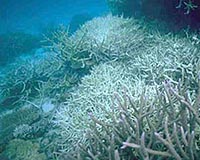 Malaysia may close more dive sites hit by coral bleaching
Kuala Lumpur (AFP) July 28, 2010 Malaysia may close three more popular dive sites in the South China Sea which have been hit by coral bleaching blamed on global warming, an official said Wednesday. Last week authorities announced the closure of nine dive sites on the tropical islands of Tioman and Redang until the end of October in an attempt to relieve stress on the fragile marine ecosystems. The two islands are locate ... read more |
|
|
| The content herein, unless otherwise known to be public domain, are Copyright 1995-2010 - SpaceDaily. AFP and UPI Wire Stories are copyright Agence France-Presse and United Press International. ESA Portal Reports are copyright European Space Agency. All NASA sourced material is public domain. Additional copyrights may apply in whole or part to other bona fide parties. Advertising does not imply endorsement,agreement or approval of any opinions, statements or information provided by SpaceDaily on any Web page published or hosted by SpaceDaily. Privacy Statement |


 del.icio.us
 Digg
Digg Reddit
 YahooMyWeb
 Google
 Facebook


