
 |
 |
 |
 |
 |
 |
 |
 |
 |

 |
Defense Focus: Age Of Wars Part Five
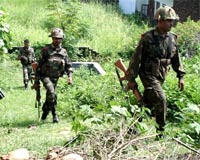
Washington, April 27, 2009 India has poor special forces, but its enormous manpower gives it a powerful advantage in maintaining security and fighting guerrilla conflicts. This model flies in the face of the fashionable and currently widely accepted theories of military force deployment and weapons procurement spearheaded by the United States and followed by almost of all of the major industrialized democracies. Indeed, French President Nicolas Sarkozy embarked on an ambitious program last year to drastically cut the size and manpower numbers of the French armed forces while pouring far more investment into high-tech weapons, space-based command and communications and long-distance force-projection capabilities instead. It always sounds so attractive, and it was the mantra that Donald Rumsfeld followed during his six years as defense secretary of the United States. But it didn't work well at all for the United States and its armed forces. The U.S. military had to pour a disproportionate percentage of its combat forces into a long and exhausting guerrilla conflict against Baathist and other Sunni Muslim guerrillas operating among a minority of only around 30 percent or less of the total population of Iraq, an average-sized country that is only as large as California and with a population half the size. But in fighting counterinsurgency wars and in struggling to prevent the erosion of the state to entropy or chaos -- generating forces of fourth-generation war -- the most important goal for armies to achieve is the protection of the population from being terrorized and coerced by the ruthless guerrilla forces seeking to co-opt them. U.S. Gen. David Petraeus has applied that principle with brilliant success in central Iraq over the past two years after about four years of continual failure before him. Petraeus was able to pull off his achievement despite a strict limitation on the number of troops he was able to concentrate on the ground. And the super-expensive high-tech weaponry that Rumsfeld loved proved to be totally irrelevant to his achievement. Petraeus was able to pull off his success by co-opting and paying local Iraqi tribal leaders who had been disgusted by the out-of-control violence and cruelty of al-Qaida and other insurgent forces. The Indian army continues to fight guerrilla and terrorist challenges on a number of fronts, and it has achieved considerable success against them using two low-tech and very old-fashioned and unfashionable forces. It has not sought to bribe or politically co-opt its enemies as the British Empire did for centuries around the world with mixed but generally positive results and as Petraeus more recently did in Iraq. The Indians have relied on strong passive border defenses to keep mujahedin Islamist guerrillas from wreaking havoc in Muslim-majority Jammu & Kashmir or across their eastern border from Bangladesh. But above all else, they have trusted in having large numbers of relatively low-trained and lightly equipped combat soldiers who can flood areas threatened by guerrillas for long periods at a time. Part 5: Lessons to learn from India's army Share This Article With Planet Earth
Related Links
 Sri Lanka 'stops heavy guns', but offers no truce to Tamil Tigers
 Colombo (AFP) April 27, 2009
Sri Lanka announced Monday it was halting the use of heavy weapons and air strikes to spare civilian lives in its battle against the Tamil Tigers, but asserted it was not calling a truce. |
|
|

| The content herein, unless otherwise known to be public domain, are Copyright 1995-2007 - SpaceDaily.AFP and UPI Wire Stories are copyright Agence France-Presse and United Press International. ESA Portal Reports are copyright European Space Agency. All NASA sourced material is public domain. Additional copyrights may apply in whole or part to other bona fide parties. Advertising does not imply endorsement,agreement or approval of any opinions, statements or information provided by SpaceDaily on any Web page published or hosted by SpaceDaily. Privacy Statement |
 del.icio.us
 Digg
Digg Reddit
 YahooMyWeb
 Google
 Facebook