
 |
 |
 |
 |
 |
 |
 |
 |
 |

 |
Defense Focus: Russia-China arms slump
Washington (UPI) Feb 10, 2009 Far from rising, as so many Western pundits have predicted for so long, Russian arms sales to China may plummet by at least 75 percent in the immediate future, the CEO of Russia's main official arms exporting corporation warned last Wednesday. Arms exports to China could shrivel from the current 40 percent of the value of annual Russian arms exports to only 10 percent, Anatoly Isaikin, general director of Rosoboronexport, told the Moscow daily newspaper Nezavisimaya Gazeta in an interview published Feb. 4, RIA Novosti reported. As we have reported often in these columns, Sino-Russian relations have soured in recent years over one key issue: the continuing refusal of the Russian government under both Russian Presidents Vladimir Putin and Dmitry Medvedev to sell China any of the long shopping list of advanced, expensive ground warfare and Close Air Support weapons that China still cannot produce but desperately needs to become a truly formidable major military power. Russia has been willing to sell China air defense systems, older combat aircraft and many classes of warships, including Kilo-class diesel submarines that Beijing could use in any future conventional war against the United States. But it has flatly refused to part with any of its "crown jewels" or the industrial capabilities to manufacture them. RIA Novosti noted that since the collapse of communism, Russia has allowed China to purchase Sukhoi Su-27 Flanker and Sukhoi Su-30 combat aircraft, Varshavyanka-class diesel submarines along with other weapons systems. However, Isaikin's comments will come as a major disappointment to China's leaders. They also will surprise many Western analysts. The Russian government is no longer sitting on a huge foreign currency surplus from high global sales prices for its oil and gas exports. Russia is the second-largest oil exporter in the world and the second-largest combined oil and gas exporter. However, global oil prices must remain above $90 a barrel for Russia to break even. They are still hovering around $40 a barrel and plunged as low as $34 a barrel recently. Yet Isaikin said the Russian government would not worry, even if it lost a large chunk of the current level of arms exports to China. "After all, sales volumes (across the world) are still high," he told Nezavisimaya Gazeta. However, Isaikin also had some positive things to say about future Russian arms and technology exports to China. He claimed that Russian technical joint activity with China "is reaching a fundamentally new level -- the development of dual-purpose products with high-tech components." Isaikin also announced that in the past month Russia had approved a new agreement to manufacture and export more than 100 engines for China's J-10 fighter. He also confirmed that China would continue to purchase Russian military transport aircraft, aerial fuel tankers and aircraft engines as well as more air defense and naval systems. According to Russian experts, the General Armaments Department of China's People's Liberation Army wants to buy large batches of Russian-made Shmel ("Bumblebee") rocket infantry flame-throwers, 120mm Nona-SVK and Vena self-propelled guns, 152mm Msta-S self-propelled artillery systems, 300mm Smerch ("Tornado") multiple-launch rocket systems, BMP-3 infantry fighting vehicles, BTR-80 armored personnel carriers, Mil Mi-28N ("Havoc") and Kamov Ka-50 Black Shark ("Hokum") attack helicopters, various types of 3-D radars, naval Shtil-1 R-29RM -- SS-N-23 -- surface-to-air missiles on vertical launchers, as well as electronic countermeasures systems, Kamov Ka-27 and Ka-28 ("Helix") ship-borne helicopters, know-how for manufacturing fourth-generation and fifth-generation aircraft engines, highly alloyed steels and other materials. In other words, it can safely be said that China's arms industry, for all the country's astonishing economic and industrial achievements, is still incapable of making a vast range of weapons, especially for land warfare and tactical air support of ground operations that it must buy from other sources. Share This Article With Planet Earth
Related Links The Military Industrial Complex at SpaceWar.com Learn about the Superpowers of the 21st Century at SpaceWar.com
 Airbus A400M military transport facing three-year delay: report
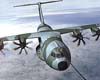 Paris (AFP) Feb 10, 2009
Airbus's flagship A400M military transport plane is facing a three-year delay, Le Figaro reported Tuesday, adding an estimated five billion euros to its price tag. |
|
|

| The content herein, unless otherwise known to be public domain, are Copyright 1995-2007 - SpaceDaily.AFP and UPI Wire Stories are copyright Agence France-Presse and United Press International. ESA Portal Reports are copyright European Space Agency. All NASA sourced material is public domain. Additional copyrights may apply in whole or part to other bona fide parties. Advertising does not imply endorsement,agreement or approval of any opinions, statements or information provided by SpaceDaily on any Web page published or hosted by SpaceDaily. Privacy Statement |
 del.icio.us
 Digg
Digg Reddit
 YahooMyWeb
 Google
 Facebook