
 |
 |
 |
 |
 |
 |
 |
 |
 |

 |

Washington DC (SPX) Sep 06, 2010 NASA's Desert RATS - or Research and Technology Studies - are making their 13th trip to the desert this fall for another round of analog testing. The Desert RATS tests offer a chance for a NASA-led team of engineers, astronauts and scientists from across the country to come together to conduct technology development research in the Arizona desert. The location offers a good stand-in for destinations for future planetary exploration missions. This year's tests take place Aug. 31 through Sept. 15. The NASA hardware being demonstrated includes: Space Exploration Vehicles - a pair of rovers that astronauts will live in for 7 days at a time Habitat Demonstration Unit/Pressurized Excursion Module - a simulated habitat where the rovers can dock to allow the crew room to perform experiments or deal with medical issues Tri-ATHLETEs, or -Terrain Hex-Legged Extra-Terrestrial Explorer - two heavy-lift rover platforms that allow the habitat, or other large items, to go where the action is portable communications terminals Centaur 2 - a possible four-wheeled transportation method for NASA Robonaut 2 Portable Utility Pallets, or PUPs for short - mobile charging stations for equipment And a suite of new geology sample collection tools, including a self-contained GeoLab glove box for conducting in-field analysis of various collected rock samples. In addition, a variety of independent supporting technology elements, including navigation systems to help guide spacewalkers and both solar and wind-powered equipment, will be demonstrated and tested. During this mission, there will be four crew members living in the two rovers. Their traverse routes will include driving up and down steep slopes and over rough terrain at various speeds. The crew will also demonstrate docking and undocking with the PUPs and the habitat. Other objectives for the rovers include demonstrating the differences in productivity for crew members and their ground support that come with different communication methods, and evaluating different operational concepts for the trips the rovers make. The ATHLETE System, which consists of a pair of Tri-ATHLETE rovers, will be remotely controlled both in Arizona and from Houston to demonstrate long-traverse operations during lunar time delays and portable local operations from the personnel in Arizona. The Habitat Development Unit will be used to evaluate the geosciences laboratory in conjunction with the sample collections and to assess the spacesuit maintenance area inside. This team will also focus on procedures for keeping out the dust, the effects on the overall integrated communications and data system and how easy the habitat is for people to use. For more information on all of these hardware systems, biographies of the crew and mission support teams, traverse locations and success of mission objectives, check out our factsheets and follow the mission on our social media sites.
Share This Article With Planet Earth
Related Links NASA Desert RATS Space Tourism, Space Transport and Space Exploration News

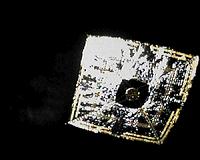 Setting Sail In The Sun
Moffett Field CA (SPX) Sep 03, 2010 By rigging large pieces of cloth atop boats, early explorers harnessed the wind to voyage across oceans. Now, modern space explorers want to use sails to send spacecraft to the far reaches of the solar system and beyond. These sails will be made of large, ultra-thin gossamer plastic sheets that, instead of wind, will be propelled using sunlight. Light particles, or photons, exert a small p ... read more |
|
|
| The content herein, unless otherwise known to be public domain, are Copyright 1995-2010 - SpaceDaily. AFP and UPI Wire Stories are copyright Agence France-Presse and United Press International. ESA Portal Reports are copyright European Space Agency. All NASA sourced material is public domain. Additional copyrights may apply in whole or part to other bona fide parties. Advertising does not imply endorsement,agreement or approval of any opinions, statements or information provided by SpaceDaily on any Web page published or hosted by SpaceDaily. Privacy Statement |


 del.icio.us
 Digg
Digg Reddit
 YahooMyWeb
 Google
 Facebook


