
 |
 |
 |
 |
 |
 |
 |
 |
 |

 |

Leicester, UK (SPX) Aug 05, 2010 An international team of scientists led by Dr Jonathan Nichols of the University of Leicester has discovered that Saturn's aurora, an ethereal ultraviolet glow which illuminates Saturn's upper atmosphere near the poles, pulses roughly once per Saturnian day. The length of a Saturnian day has been under much discussion since it was discovered that the traditional 'clock' used to measure the rotation period of Saturn, a gas giant planet with no solid surface for reference, apparently does not keep good time. Saturn, like all magnetised planets, emits radio waves into space from the polar regions. These radio emissions pulse with a period near to 11 h, and the timing of the pulses was originally, during the Voyager era, thought to represent the rotation of the planet. However, over the years the period of the pulsing of the radio emissions has varied, and since the rotation of a planet cannot be easily sped up or slowed down, the hunt for the source of the varying radio period has become one of the most perplexing puzzles in planetary science. Now, in a paper to be published in Geophysical Research Letters, Nichols et al. use images from the NASA/ESA Hubble Space Telescope of Saturn's auroras obtained between 2005-2009 to show that, not only do the radio emissions pulse, but the auroras beat in tandem with the radio. Dr Nichols said: "This is an important discovery for two reasons. First, it provides a long-suspected but hitherto missing link between the radio and auroral emissions, and second, it adds a critical tool in diagnosing the cause of Saturn's irregular heartbeat." Auroras, more commonly known as the "northern lights" on Earth, are caused when charged particles in space are funnelled along a planet's magnetic field into the planet's upper atmosphere near the poles, whereupon they impact the atmospheric particles and cause them to glow. This happens when a planet's magnetic field is stressed by, for example, the buffeting from the stream of particles emitted by the Sun, or when moons such as Enceladus or Io expel material into the near-planet space. Saturn's radio waves were long suspected to be emitted by the charged particles as they hurtle toward the poles, but no radio-like pulsing had been observed in Saturn's aurora, an enigmatic disconnect between the two supposedly-related phenomena. However, Nichols et al. found that by using the clock of the radio pulsing to organise the auroral data, and stacking the results from all the Hubble Saturn auroral images obtained from 2005-2009 on top of each other, the auroral pulsing finally revealed itself. Dr Nichols added: "This confirms that the auroras and the radio emissions are indeed physically associated, as suspected. This link is important, since it implies that the pulsing of the radio emissions is being imparted by the processes driving Saturn's aurora, which in turn can be studied by the NASA/ESA spacecraft Cassini, presently in orbit around Saturn. It thus takes us a significant step toward solving the mystery of the variable radio period."
Share This Article With Planet Earth
Related Links University of Leicester Explore The Ring World of Saturn and her moons Jupiter and its Moons The million outer planets of a star called Sol News Flash at Mercury

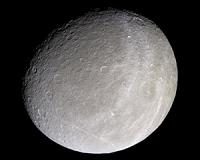 No Rings Around Saturn's Rhea
Ithaca NY (SPX) Aug 02, 2010 Something unknown is causing a strange, symmetrical structure in the charged-particle environment around Rhea, Saturn's second-largest moon. But contrary to 2008 reports, it's not a system of rings. Using NASA's orbiting Cassini spacecraft, a team of astronomers led by Cornell research associate Matthew Tiscareno searched for narrow rings, broad rings and any material from dust to giant bo ... read more |
|
|
| The content herein, unless otherwise known to be public domain, are Copyright 1995-2010 - SpaceDaily. AFP and UPI Wire Stories are copyright Agence France-Presse and United Press International. ESA Portal Reports are copyright European Space Agency. All NASA sourced material is public domain. Additional copyrights may apply in whole or part to other bona fide parties. Advertising does not imply endorsement,agreement or approval of any opinions, statements or information provided by SpaceDaily on any Web page published or hosted by SpaceDaily. Privacy Statement |


 del.icio.us
 Digg
Digg Reddit
 YahooMyWeb
 Google
 Facebook


