
 |
 |
 |
 |
 |
 |
 |
 |
 |

 |

Washington DC (SPX) Aug 30, 2010 In a bid to unlock long-standing mysteries of the sun, including the impacts on Earth of its 11-year cycle, an international team of scientists has successfully probed a distant star. By monitoring the star's sound waves, the team has observed a magnetic cycle analogous to the sun's solar cycle. Results of the study, conducted by scientists at the U.S. National Center for Atmospheric Research (NCAR) in Boulder, Colo., and colleagues in France and Spain, are published this week in the journal Science. The research was funded by the U.S. National Science Foundation (NSF), which is NCAR's sponsor, the CEA (the French Atomic Energy and Alternative Energies Commission), the French Stellar Physics National Research Plan, and the Spanish National Research Plan. "This is an interesting study that was possible due to strong international cooperation," says Steve Nelson, NSF program director for NCAR. The scientists studied a star known as HD49933, which is located 100 light years away from Earth in the constellation Monoceros, the Unicorn, just east of Orion. The team examined the star's acoustic fluctuations, using a technique called "stellar seismology." They detected the signature of "starspots," areas of intense magnetic activity on the surface that are similar to sunspots. While scientists have previously observed these magnetic cycles in other stars, this was the first time they have discovered such a cycle using stellar seismology. "Essentially, the star is ringing like a bell," says NCAR scientist Travis Metcalfe, a co-author of the paper. "As it moves through its starspot cycle, the tone and volume of the ringing changes in a very specific pattern, moving to higher tones with lower volume at the peak of its magnetic cycle." The technique could open the way to observing the magnetic activity of hundreds of stars, which could help evaluate new solar systems for the potential of supporting life. Studying many stars this way could help scientists better understand how magnetic activity cycles can differ from star to star, as well as the processes behind such cycles. The work could especially shed light on the magnetic activity processes that go on within the sun, furthering our understanding of its influence on Earth's climate. It could also lead to better predictions of the solar cycle and resulting geomagnetic storms that can cause major disruption to power grids and communication networks. "We've discovered a magnetic activity cycle in this star, similar to what we see with the sun," says co-author and NCAR scientist Savita Mathur. "This technique of listening to the stars will allow us to examine potentially hundreds of stars." In addition to NCAR, the team's scientists are from France's Center for Nuclear Studies of Saclay (CEA-Saclay), Paris/Meudon Observatory (OPM), the University of Toulouse, and Spain's Institute of Astrophysics of the Canaries (IAC). The team hopes to assess the potential for other stars in our galaxy to host planets, including some perhaps capable of sustaining life. "Understanding the activity of stars harboring planets is necessary because magnetic conditions on the star's surface could influence the habitable zone where life could develop," says CEA-Saclay scientist Rafael Garcia, the study's lead author. The scientists examined 187 days of data captured by the international Convection Rotation and Planetary Transits (CoRoT) space mission. Launched on December 27, 2006, CoRoT was developed and is operated by the French National Center for Space Studies (CNES) with contributions of Austria, Belgium, Brazil, Germany, Spain, and the European Space Agency. CoRoT is equipped with a 27-centimeter (11-inch) diameter telescope and a 4-CCD (charge-coupled device) camera sensitive to tiny variations in the light intensity from stars. The study authors found that HD49933 is much bigger and hotter than the sun, and its magnetic cycle is much shorter. Whereas past surveys of stars have found cycles similar to the 11-year cycle of the sun, this star has a cycle of somewhat less than a year. This is important to scientists because it may enable them to observe an entire cycle more quickly, thereby gleaning more information about magnetic patterns than if they could only observe part of a longer cycle. The scientists plan to expand their observations by using other stars observed by CoRoT as well as data from NASA's Kepler mission, launched in March 2009. Kepler is seeking Earth-sized planets to survey. The mission will provide continuous data over three to five years from hundreds of stars that could potentially be hosting planets. "If it turns out that a short magnetic cycle is common in stars, then we will potentially observe a large number of full cycles during Kepler's mission," says Metcalfe. "The more stars and complete magnetic cycles we have to observe, the more we can place the sun into context and explore the impacts of magnetic activity on possible planets hosted by these stars." The team has spent the past six months exploring the structure and dynamics of HD49933 and classifying its size. They will next verify their observations using ground-based telescopes to confirm the magnetic activity of the star. When the star reemerges from behind the sun in September, they hope to measure the full length of the cycle. The CoRoT mission was designed to collect up to 150 days of continuous data at a time, which was not enough to determine the exact length of the star's cycle.
Share This Article With Planet Earth
Related Links National Science Foundation Solar Science News at SpaceDaily

 Why Are Sunspots A Source Of Radio Emissions
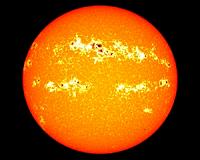
Newark NJ (SPX) Aug 30, 2010 Why sunspots are a strong source of radio emissions and what information those emissions carry will be the focus of an invited talk by NJIT Research Professor Jeongwoo Lee tomorrow at the International Astronomical Union Symposium on the Physics of Sun and Star Spots in Ventura, CA. The event numbers among the top gatherings in the U.S. for people studying sunspots and related phenomena. L ... read more |
|
|
| The content herein, unless otherwise known to be public domain, are Copyright 1995-2010 - SpaceDaily. AFP and UPI Wire Stories are copyright Agence France-Presse and United Press International. ESA Portal Reports are copyright European Space Agency. All NASA sourced material is public domain. Additional copyrights may apply in whole or part to other bona fide parties. Advertising does not imply endorsement,agreement or approval of any opinions, statements or information provided by SpaceDaily on any Web page published or hosted by SpaceDaily. Privacy Statement |


 del.icio.us
 Digg
Digg Reddit
 YahooMyWeb
 Google
 Facebook


